Our Location
304 North Cardinal St.
Dorchester Center, MA 02124

304 North Cardinal St.
Dorchester Center, MA 02124

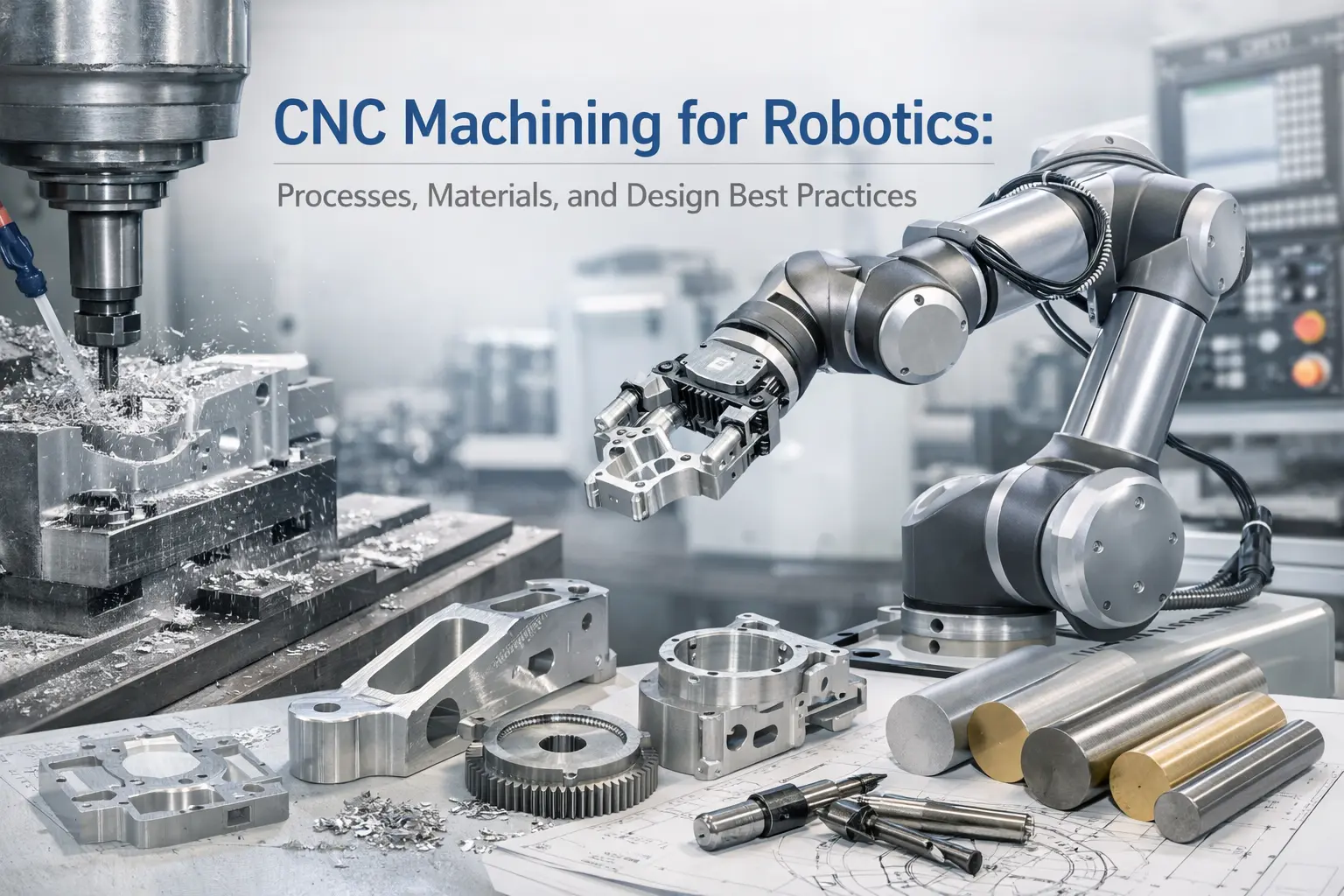
CNC machining is a foundational technology in robotics manufacturing because it enables the production of highly precise, durable, and repeatable components. Robots depend on exact motion control and structural accuracy, which means even small dimensional deviations can affect performance, stability, and lifespan. CNC machining ensures that robotic parts such as joints, frames, and housings maintain tight tolerances and consistent quality across production batches.
Compared with 3D printing, casting, or stamping, CNC machining offers superior mechanical strength and dimensional precision. While 3D printing is useful for prototyping, it often lacks the structural integrity required for load-bearing robotic components. Casting can introduce porosity and variability, and stamping is limited in geometric complexity. CNC machining bridges these gaps by delivering high accuracy, strong material properties, and excellent surface finishes.
CNC machining is widely used to produce robotic arms, motor mounts, gear systems, actuator housings, and end-effectors. These components require not only precision but also high durability to withstand repetitive motion and mechanical stress. The ability to machine both metals and engineering plastics makes CNC a versatile solution for robotics applications across industrial, medical, and consumer sectors.
CNC milling is commonly used to create complex 3D shapes such as robot frames, brackets, and structural housings. It allows multi-axis cutting, making it ideal for components with intricate geometry and tight tolerances. Milling is especially important for parts that require high rigidity and precise alignment.
CNC turning is used for cylindrical parts such as shafts, pins, and rotating joints. These components are essential in robotic motion systems where smooth rotation and concentricity are critical. Turning ensures high roundness accuracy and excellent surface finish, which directly impacts mechanical efficiency and wear resistance.
👉 For a deeper comparison of these two core processes, you can refer to this guide:
https://winsunproto.com/cnc-turning-vs-milling-complete-comparison-and-practical-guide/
5-axis CNC machining enables the production of highly complex robotic components in a single setup. This reduces repositioning errors and improves overall precision. It is especially useful for advanced robotics applications where lightweight structures and organic geometries are required.
Some robotic systems, especially in medical and aerospace fields, require micro-level precision. CNC precision machining ensures extremely tight tolerances, sometimes within microns, to guarantee consistent motion and safety.
Post-processing enhances both the performance and durability of CNC-machined robotic parts. Anodizing improves corrosion resistance, polishing reduces friction, and heat treatment increases hardness and fatigue resistance, all of which are crucial for long-term robotic operation.
Aluminum alloys are widely used due to their excellent strength-to-weight ratio. They help reduce overall robot weight while maintaining structural integrity, making them ideal for moving parts and frames.
Stainless steel is chosen for components requiring high durability and resistance to wear, corrosion, and mechanical stress. It is commonly used in joints and load-bearing structures.
Titanium offers exceptional strength while remaining lightweight. It is often used in aerospace and high-end robotics where performance and reliability are critical.
Engineering plastics provide electrical insulation, reduced friction, and lightweight properties. Materials like POM, PEEK, and Nylon are widely used in gears, bushings, and non-structural components.
Composites are increasingly used in robotics for their high strength-to-weight ratio and vibration-damping properties, especially in advanced automation systems.
Reducing weight is crucial in robotics because lighter components improve speed, energy efficiency, and overall system responsiveness. Engineers often design hollow structures or use lightweight materials to achieve this balance.
Robotic systems require extremely tight tolerances to ensure accurate positioning and repeatable motion. Even minor deviations can affect calibration and performance.
Proper stress distribution ensures that robotic components can handle repeated loads without deformation or failure. Finite element analysis (FEA) is often used during the design stage.
Vibration can reduce precision and increase wear in robotic systems. Designers focus on stiffness optimization and damping strategies to improve stability.
Modular design allows easier maintenance, faster assembly, and improved scalability in robotic systems, especially in industrial automation environments.
In robotics manufacturing, choosing the correct CNC process for each part is critical to achieving both performance and cost efficiency. Structural frames often require milling, while rotational components rely on turning. Complex geometries may demand 5-axis machining. Understanding when to apply each process helps optimize production time, reduce errors, and improve overall part quality.
Material selection directly impacts the performance and lifespan of robotic systems. For example, aluminum is preferred for lightweight structures, stainless steel for high-wear environments, and engineering plastics for low-friction or insulated components. Engineers must consider temperature, load, and operating conditions before finalizing material choices.
Design for manufacturability is essential in CNC machining for robotics. Good DFM practices reduce unnecessary complexity, avoid deep cavities that increase machining difficulty, and ensure tool accessibility. Proper design can significantly reduce production costs while improving consistency and machining efficiency.
Cost optimization in robotics CNC machining involves balancing precision requirements with efficient production strategies. This includes minimizing setup changes, optimizing tool paths, and selecting cost-effective materials without sacrificing mechanical performance.
Robotics components require strict quality control to ensure reliability. Common inspection methods include CMM measurement, laser scanning, and surface finish analysis. These checks ensure that every part meets dimensional accuracy and functional requirements before assembly.
CNC-machined parts are widely used in industrial robots for assembly lines, welding systems, and automated handling equipment. These systems demand high durability and precision to operate continuously in high-speed environments.
In medical robotics, precision is critical. CNC machining is used to produce surgical tools, robotic arms, and positioning systems that require micron-level accuracy and high biocompatibility.
Aerospace robotics rely on CNC-machined components for UAV systems, satellite mechanisms, and defense automation equipment. These parts must be lightweight yet extremely strong to withstand harsh operating conditions.
Service robots used in logistics, cleaning, and customer interaction also rely on CNC-machined components for structural stability and motion control systems.
Humanoid robots require highly complex structures that mimic human movement. CNC machining enables precise fabrication of joints, skeletal frames, and motion linkages.
One of the biggest challenges in robotics manufacturing is maintaining ultra-tight tolerances. Even minor deviations can affect motion accuracy, balance, and system calibration.
Although 5-axis machining has expanded capabilities, extremely complex geometries can still pose challenges in tool access and setup efficiency.
CNC machining is a subtractive process, which naturally generates material waste. Managing material usage efficiently is important to control production costs, especially for expensive metals like titanium.
Robotics design often requires a trade-off between strength and weight. Engineers must carefully optimize structures to ensure durability without compromising speed and energy efficiency.
Artificial intelligence is increasingly being integrated into CNC machining systems to optimize tool paths, predict maintenance needs, and improve machining accuracy.
Hybrid approaches combine CNC machining with 3D printing to achieve both geometric complexity and high precision, offering new possibilities for robotics design.
Fully automated machining systems allow continuous production with minimal human intervention, improving efficiency and reducing labor costs.
As robotics becomes more advanced, demand for micro-scale components with ultra-high precision continues to grow, especially in medical and aerospace applications.
CNC machining remains one of the most important manufacturing technologies in robotics due to its unmatched precision, material flexibility, and scalability. As robotic systems become more advanced, the need for tighter tolerances, lighter structures, and more complex geometries continues to increase.
For engineers and manufacturers, mastering CNC machining processes, material selection, and design optimization is essential for building high-performance robotic systems that meet modern industry demands.
