Our Location
304 North Cardinal St.
Dorchester Center, MA 02124

304 North Cardinal St.
Dorchester Center, MA 02124

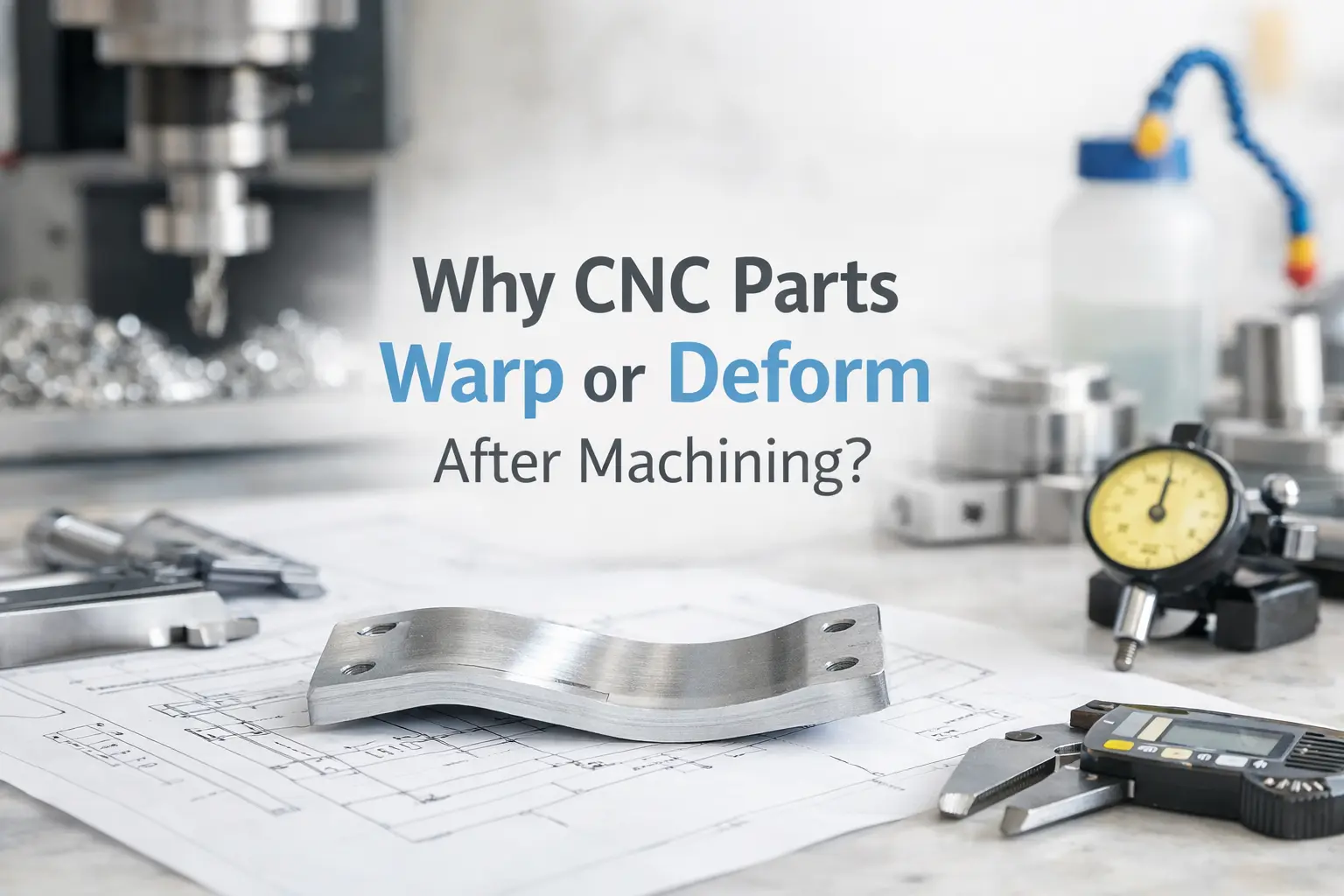
CNC machining warping and CNC part deformation refer to the unwanted change in the shape, geometry, or dimensions of a component during or after the machining process. This issue is especially common in precision CNC machining, where tight tolerances, complex geometries, and high surface finish requirements make parts more sensitive to internal and external stresses. Warping can appear in different forms, including bending, twisting, bowing, or even subtle dimensional deviations that are difficult to detect without precise measurement tools such as CMM inspection systems.
One of the primary reasons behind CNC machining deformation is the presence of residual stress within the raw material. Materials such as aluminum alloys, stainless steel, and engineering plastics often contain internal stresses introduced during rolling, casting, forging, or extrusion processes. When CNC machining removes material—especially in an uneven or non-symmetrical way—these stresses are redistributed and released. As a result, the part may shift from its original geometry, leading to visible or hidden deformation. This is particularly critical in thin wall CNC machining, where the structural rigidity of the part is low and even minor stress imbalances can cause significant warping.
In addition to residual stress, factors such as cutting forces, toolpath strategy, fixturing methods, and heat generation during machining all contribute to CNC part deformation. For example, aggressive cutting parameters may introduce excessive mechanical stress, while high spindle speeds can generate heat that leads to thermal expansion. When the part cools down after machining, uneven contraction can result in permanent deformation. This combination of mechanical and thermal influences makes CNC machining deformation a complex, multi-factor problem that cannot be solved by a single adjustment.
Understanding CNC machining warping is essential for manufacturers aiming to achieve high precision and consistent quality. Engineers must consider not only the machining process itself but also upstream factors such as material selection and downstream processes such as post-machining stress relief. By identifying the root causes of deformation early in the design and manufacturing stages, companies can significantly reduce scrap rates, improve dimensional accuracy, and lower overall production costs. This is why addressing CNC part warping is not just a technical necessity, but also a key factor in maintaining competitiveness in high-precision manufacturing industries.
CNC part deformation is not just a minor machining defect—it is a critical issue that can directly impact product performance, assembly accuracy, and overall manufacturing efficiency. In industries such as aerospace, automotive, medical devices, and electronics, even the smallest deviation from specified tolerances can lead to functional failure or costly rework. As a result, understanding and controlling CNC machining deformation has become a top priority for manufacturers aiming to deliver high-quality, precision-engineered components.
One of the most significant consequences of CNC machining warping is the loss of dimensional accuracy. Modern CNC machining often requires tolerances within microns, especially for components that must fit together in complex assemblies. When a part deforms after machining, it may no longer meet these tight specifications, making it unsuitable for its intended application. This can lead to assembly issues such as misalignment, excessive wear, or even complete system failure. In high-performance applications, such as aerospace components or medical implants, such deviations are unacceptable and can result in serious safety risks.
Another major impact of CNC part deformation is the increase in production costs. Warped parts often require additional processes such as re-machining, manual straightening, or stress relief heat treatment. These secondary operations not only add time and labor costs but also increase the risk of further defects. In some cases, the deformation may be too severe to correct, resulting in scrapped parts and wasted material. This is particularly problematic when working with expensive materials such as aerospace-grade aluminum or titanium alloys, where material costs are already high.
CNC machining deformation also affects production efficiency and lead times. When parts need to be reworked or remanufactured, production schedules can be delayed, impacting delivery timelines and customer satisfaction. In competitive markets, delays can lead to lost business opportunities and damage to a company’s reputation. Moreover, inconsistent part quality caused by uncontrolled deformation can make it difficult to maintain stable production processes, further reducing overall efficiency.
From a quality control perspective, CNC part warping introduces additional complexity in inspection and validation. Manufacturers may need to implement more advanced inspection techniques, such as 3D scanning or coordinate measuring machines, to detect subtle deformations. This increases both the cost and time required for quality assurance. Therefore, preventing deformation at the source is always more efficient than trying to detect and correct it after the fact.
Identifying CNC machining warping early is essential for maintaining product quality and preventing costly downstream issues. However, deformation is not always immediately visible, especially in high-precision CNC machined parts where deviations can be very small. Understanding the common signs of CNC part deformation allows engineers and machinists to detect problems early and take corrective actions before the parts move further along the production process.
One of the most obvious signs of CNC part warping is visible bending or distortion. This is particularly common in thin wall CNC parts, where the lack of structural rigidity makes them more susceptible to deformation. For example, a flat plate may appear slightly curved after machining, or a long, slender component may show signs of twisting. These visible deformations are usually caused by uneven material removal, residual stress release, or improper clamping during machining. While such defects can sometimes be corrected, they often indicate deeper process issues that need to be addressed.
Another common indicator of CNC machining deformation is dimensional inconsistency. Even if a part appears visually acceptable, it may fail to meet tolerance requirements when measured with precision instruments. For instance, holes may become slightly oval instead of perfectly round, or critical dimensions may vary across different sections of the part. These deviations are often the result of internal stress redistribution or thermal effects during machining. In high-precision applications, even a small dimensional error can render a part unusable.
Surface irregularities can also signal the presence of CNC part warping. Uneven surface finish, tool marks, or localized roughness may indicate that the part moved or vibrated during machining due to insufficient rigidity or improper fixturing. In some cases, deformation can cause the cutting tool to engage unevenly with the material, leading to inconsistent surface quality. This not only affects the appearance of the part but can also impact its functional performance, especially in applications requiring smooth contact surfaces.
Another subtle but important sign of deformation is difficulty during assembly. Parts that do not fit properly, require excessive force to assemble, or show signs of misalignment may have experienced warping during machining. This is often the first indication of a problem in mass production, where individual parts may pass inspection but fail when combined with other components. Such issues highlight the importance of considering deformation not just at the individual part level, but also within the context of the entire assembly.
By recognizing these common signs of CNC machining warping, manufacturers can implement better monitoring and control strategies. Early detection allows for timely adjustments in machining parameters, fixturing methods, or material selection, ultimately reducing the risk of defects and improving overall product quality.
One of the most significant causes of CNC machining deformation is residual stress in raw materials. These internal stresses are introduced during material production processes such as rolling, casting, forging, and extrusion. Materials like aluminum alloys, stainless steel, and engineering plastics often retain uneven internal stress distributions even before machining begins. When CNC machining removes material, especially in large volumes or asymmetrically, the equilibrium of these stresses is disturbed, leading to sudden stress release and deformation.
For example, aluminum extrusions are widely used in CNC machining due to their lightweight and machinability, but they are also highly prone to warping because of internal stress from extrusion. When one side of the material is machined more heavily than the other, the stress imbalance causes the part to bend or twist. This issue is particularly severe in thin wall CNC parts, where there is insufficient rigidity to resist deformation. Without proper stress-relief treatment such as aging or annealing, even high-quality materials can deform significantly during machining.
Improper fixturing is another major contributor to CNC part warping. During machining, parts must be securely held in place using clamps, vises, or custom fixtures. However, excessive clamping force or uneven support can introduce external stress into the workpiece. When the clamps are released after machining, the stored stress is suddenly released, causing the part to deform.
This problem is especially common in thin and complex geometries, where traditional clamping methods may not provide uniform support. For instance, if a thin plate is clamped only at its edges, the center may flex during machining, resulting in inaccurate dimensions or permanent deformation. Advanced fixturing solutions such as vacuum fixtures, soft jaws, and multi-point support systems are often required to minimize distortion and ensure stability throughout the machining process.
Cutting forces play a crucial role in CNC machining deformation. High cutting forces generated by aggressive machining parameters—such as high feed rates, deep cuts, or dull tools—can introduce mechanical stress into the part. This stress can exceed the material’s elastic limit, causing permanent deformation.
Incorrect tool selection can further exacerbate the issue. For example, using a tool that is not optimized for the material or geometry can result in uneven cutting forces and vibrations. These vibrations not only affect surface finish but also contribute to structural instability, especially in thin wall or long components. Optimizing machining parameters, including spindle speed, feed rate, and depth of cut, is essential to reduce cutting forces and minimize deformation.
Thermal effects are another critical factor in CNC machining warping. During high-speed machining, significant heat is generated at the cutting interface. This heat can cause localized thermal expansion of the material, temporarily altering its shape. Once the machining process is complete and the part cools down, uneven contraction can result in permanent deformation.
Materials such as plastics and aluminum are particularly sensitive to temperature changes. In plastic CNC machining, even a small increase in temperature can soften the material, making it more susceptible to deformation under cutting forces. Without proper cooling strategies—such as the use of cutting fluids or air cooling—thermal deformation can become a serious issue, especially in high-precision applications.
Uneven material removal is a common but often overlooked cause of CNC machining deformation. When material is removed from one side of the part more than the other, the internal stress distribution becomes unbalanced. This imbalance leads to bending or twisting as the part attempts to reach a new equilibrium.
This issue is particularly evident in parts with complex geometries or deep cavities. For example, machining a deep pocket on one side of a block can cause the remaining material to deform due to stress redistribution. To prevent this, machinists often use symmetrical machining strategies, removing material evenly from both sides and in multiple stages.
Thin wall CNC parts are inherently more prone to deformation due to their low structural rigidity. When the wall thickness is too small, the part cannot withstand cutting forces, clamping pressure, or internal stress release. Even minor external forces can cause significant deflection or permanent deformation.
Designing parts with uniform wall thickness and adding reinforcement features such as ribs can help improve rigidity. Additionally, specialized machining strategies—such as light cuts, reduced feed rates, and optimized toolpaths—are necessary to minimize deformation in thin wall components.
Aluminum alloys, especially 6061 and 7075, are among the most commonly used materials in CNC machining due to their excellent machinability and lightweight properties. However, they are also highly prone to CNC machining warping. This is primarily because aluminum has relatively low stiffness compared to steel and is more sensitive to residual stress and thermal expansion.
During machining, aluminum parts can easily deform when internal stresses are released or when exposed to heat. Thin wall aluminum components are particularly vulnerable, as they lack the rigidity needed to resist deformation. To mitigate this issue, manufacturers often use stress-relieved aluminum stock and adopt multi-stage machining strategies.
Stainless steel is another material that can experience deformation during CNC machining, although for different reasons than aluminum. Stainless steel has higher strength and hardness, which results in greater cutting forces and heat generation during machining. These factors can lead to localized stress and thermal distortion.
Additionally, stainless steel tends to work-harden, making it more difficult to machine consistently. This can result in uneven cutting forces and increased risk of deformation, particularly in complex geometries or thin sections. Proper tool selection and controlled machining parameters are essential when working with stainless steel.
Engineering plastics such as ABS, nylon, and POM are highly susceptible to deformation during CNC machining. Unlike metals, plastics have lower melting points and are more sensitive to heat and mechanical stress. During machining, heat buildup can cause softening, leading to dimensional instability and warping.
Moreover, some plastics, such as nylon, are hygroscopic and can absorb moisture from the environment. Changes in humidity can lead to dimensional changes even after machining is complete. To reduce deformation, it is important to control machining temperatures and store materials in stable environmental conditions.
Different materials exhibit varying levels of susceptibility to CNC machining deformation. In general, materials with lower stiffness and higher thermal expansion coefficients are more prone to warping. Aluminum and plastics fall into this category, while materials like carbon steel tend to be more stable.
However, no material is completely immune to deformation. The key is to understand the specific characteristics of each material and adjust machining strategies accordingly. Proper material selection, combined with optimized machining processes, can significantly reduce the risk of warping.
One of the most effective ways to prevent CNC machining deformation is to start with stress-relieved materials. Heat treatments such as annealing or aging can significantly reduce internal stress, making the material more stable during machining. This is especially important for aluminum and steel components used in high-precision applications.
A well-planned machining strategy is critical for minimizing deformation. Instead of removing large amounts of material in a single operation, it is better to use a staged approach that includes roughing, semi-finishing, and finishing. This allows stresses to be released gradually and reduces the risk of sudden deformation.
Proper fixturing is essential for maintaining part stability during machining. Using custom fixtures, soft jaws, or vacuum clamping can help distribute forces evenly and reduce stress concentrations. Minimizing clamping force while ensuring sufficient support is key to preventing deformation.
Selecting the right cutting tools and parameters can significantly reduce cutting forces. Sharp tools, appropriate coatings, and optimized cutting conditions help ensure smooth material removal and minimize mechanical stress on the part.
Managing heat during machining is crucial for preventing thermal deformation. The use of cutting fluids or air cooling can help dissipate heat and maintain stable temperatures. This is particularly important when machining heat-sensitive materials such as plastics and aluminum.
Leaving a small amount of material for a final finishing pass allows for correction of minor deformations that occur during earlier stages. This finishing operation helps achieve the desired dimensions and surface quality with minimal stress.
One of the most effective methods to fix warped CNC parts is stress relief heat treatment. This process involves heating the machined component to a controlled temperature and then slowly cooling it down to reduce internal stresses. By redistributing and relaxing residual stress, the part can return closer to its intended shape or at least stabilize enough for further machining.
This method is particularly useful for aluminum alloys and steel components that experience deformation due to internal stress release during machining. In many cases, manufacturers intentionally perform rough machining first, followed by stress relief heat treatment, and then finish machining. This staged approach ensures that most deformation occurs before the final precision cuts, improving overall dimensional stability.
Mechanical straightening is another commonly used technique to correct CNC machining deformation. This method involves applying controlled force to the warped area to bring the part back into tolerance. It can be done manually or with specialized fixtures and presses, depending on the complexity and size of the part.
However, mechanical correction requires experience and precision. Excessive force can introduce new stresses or even damage the part. This method is best suited for simple geometries or parts with minor deformation. For high-precision components, mechanical straightening is often combined with other methods such as re-machining or heat treatment to achieve optimal results.
Re-machining is often necessary when deformation exceeds acceptable limits. In this process, the part is re-fixtured and machined again to bring it back within tolerance. This may involve light finishing passes, surface grinding, or precision milling.
To ensure success, proper fixturing is critical during re-machining. The part must be held in a way that reflects its natural, stress-free state. Otherwise, additional deformation may occur after unclamping. While effective, re-machining increases production time and cost, so it is generally considered a corrective measure rather than a preferred solution.
Not all warped CNC parts can or should be repaired. Deciding whether to fix or scrap a part depends on several factors, including the severity of deformation, material cost, tolerance requirements, and intended application. For high-value materials or critical components, repair may be justified. However, for low-cost parts or severe deformation, scrapping may be more economical.
A clear evaluation process helps manufacturers minimize losses and maintain production efficiency. Preventing deformation in the first place is always more cost-effective than repairing or replacing defective parts.
Thin wall structures are one of the leading causes of CNC machining deformation. When wall thickness is too small, the part lacks the rigidity needed to resist cutting forces and internal stress release. As a result, even minor machining forces can cause bending or distortion.
Whenever possible, designers should avoid excessively thin walls or ensure that proper support strategies are in place during machining. Increasing wall thickness, even slightly, can significantly improve structural stability and reduce the risk of warping.
Uniform wall thickness is critical for maintaining balanced stress distribution throughout the part. Variations in thickness can lead to uneven material removal and stress concentration, increasing the likelihood of deformation.
By designing parts with consistent wall thickness, manufacturers can achieve more predictable machining behavior and reduce the risk of distortion. This principle is especially important in complex parts with multiple features and cavities.
Adding ribs or reinforcement features is an effective way to improve the rigidity of CNC machined parts. These structural elements help distribute stress more evenly and provide additional support during machining.
Reinforcement is particularly useful in large or thin components where maintaining dimensional stability is challenging. Properly designed ribs can enhance both mechanical strength and resistance to deformation without significantly increasing weight or material usage.
Symmetry plays a key role in minimizing CNC machining deformation. Asymmetrical designs often lead to uneven material removal and stress imbalance, which can cause warping during or after machining.
Designing parts with symmetrical features allows for more balanced machining operations and reduces the likelihood of stress-induced deformation. When symmetry is not possible, careful planning of machining sequences can help mitigate potential issues.
Aluminum parts often warp due to residual stress, low stiffness, and high thermal expansion. During machining, stress is released and heat is generated, both of which contribute to deformation, especially in thin wall components.
Preventing warping in thin-wall parts requires a combination of strategies, including reducing cutting forces, using proper fixturing, machining in stages, and maintaining symmetrical material removal. Design improvements such as increasing wall thickness or adding ribs can also help.
Yes, warped parts can sometimes be fixed using heat treatment, mechanical straightening, or re-machining. However, the feasibility depends on the severity of deformation and the required tolerances.
Lower cutting forces, optimized feed rates, sharp tools, and proper cooling all help reduce deformation. Balanced machining strategies and gradual material removal are also essential.
Materials with high stiffness and low residual stress, such as carbon steel or stress-relieved alloys, are less prone to deformation. However, proper machining practices are still required to ensure stability.
CNC machining deformation is a complex but manageable challenge that affects nearly every aspect of precision manufacturing. From material selection and part design to machining strategy and post-processing, each stage plays a critical role in determining whether a part will maintain its intended shape and dimensional accuracy. Understanding the root causes of CNC part warping—such as residual stress, cutting forces, thermal effects, and improper fixturing—is the first step toward achieving consistent, high-quality results.
The most effective approach to eliminating deformation is prevention. By using stress-relieved materials, optimizing machining parameters, and designing parts with uniform thickness and adequate rigidity, manufacturers can significantly reduce the risk of warping. Additionally, implementing proper fixturing techniques and staged machining processes ensures that stress is managed and released in a controlled manner.
However, when deformation does occur, having reliable corrective methods—such as heat treatment, mechanical straightening, and re-machining—can help recover parts and minimize losses. The key is to combine technical expertise with practical experience to make informed decisions at every stage of production.
If you are looking for a reliable CNC machining partner who understands how to control deformation and deliver high-precision parts consistently, working with an experienced team is essential.
👉 We help you optimize your design, reduce CNC machining risks, and ensure stable part quality from prototype to mass production.
👉 Whether you are dealing with thin-wall components, complex geometries, or tight tolerances, we provide tailored solutions to meet your requirements.
📩 Send us your drawings today for a free DFM analysis and fast quotation!
