Our Location
304 North Cardinal St.
Dorchester Center, MA 02124

304 North Cardinal St.
Dorchester Center, MA 02124

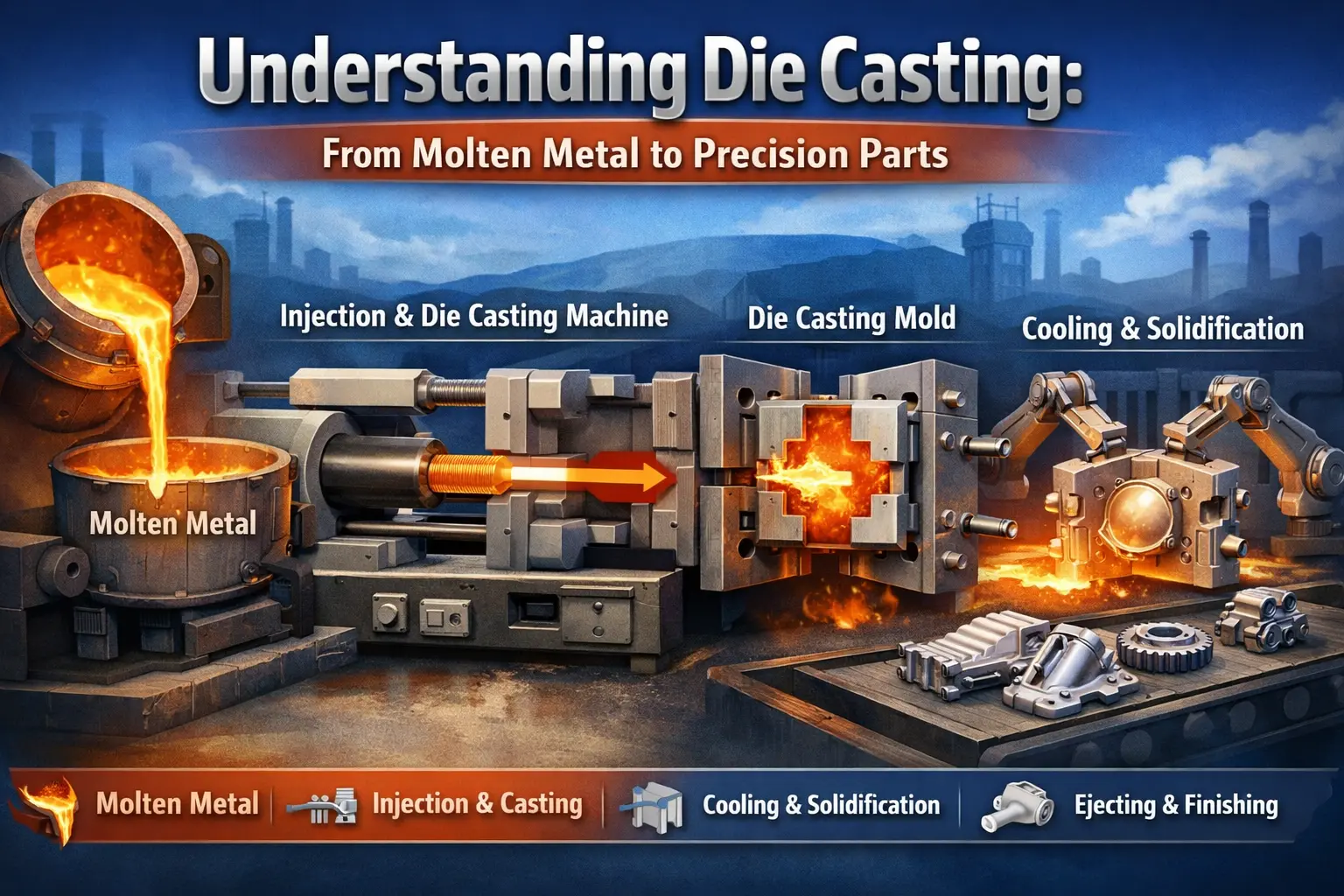
Die casting is one of the most versatile and efficient metal manufacturing processes in modern industry. It allows manufacturers to produce high-precision, complex components in large volumes while maintaining consistent quality. Industries such as automotive, aerospace, consumer electronics, and industrial machinery rely heavily on die casting due to its ability to deliver parts with tight tolerances and excellent surface finishes. Unlike traditional casting methods that rely on gravity or low-pressure pouring, die casting uses high-pressure injection to fill steel molds with molten metal. This results in components with superior dimensional accuracy and reduced need for secondary machining. The process not only saves time and cost but also enables engineers to design intricate geometries that would be difficult or impossible to achieve with conventional methods. With advancements in mold design, injection technology, and process monitoring, die casting has evolved into a highly controlled and repeatable production method. Understanding the fundamentals of die casting is crucial for designers, engineers, and production managers who want to optimize part quality, reduce defects, and improve manufacturing efficiency. In this article, we will explore the essential principles, materials, and step-by-step processes that transform raw metal into high-precision components, offering a complete guide for professionals looking to leverage die casting in modern manufacturing.
Die casting is a metal-forming process where molten metal is forced under high pressure into a reusable steel mold, often referred to as a die. This method differs significantly from traditional sand casting or gravity casting because it can achieve much higher precision and smoother surface finishes. The molds are designed to withstand repeated high-pressure injections while maintaining strict dimensional tolerances. There are several variations of die casting, including high-pressure die casting, low-pressure die casting, and vacuum-assisted die casting. High-pressure die casting is particularly suitable for mass production because it provides fast cycle times and excellent repeatability. One of the key benefits of die casting is its ability to produce complex shapes with thin walls, intricate details, and uniform mechanical properties. Additionally, the process supports a wide range of metals, including aluminum, zinc, magnesium, and copper alloys, which gives engineers flexibility in achieving desired strength, weight, and corrosion resistance. By understanding the advantages and capabilities of die casting, manufacturers can make informed decisions when selecting production methods and materials for their components. This knowledge ensures that parts meet functional requirements while minimizing costs and post-processing efforts, making die casting an indispensable tool in modern manufacturing.
Selecting the appropriate material is a critical step in die casting because it directly impacts the strength, durability, weight, and cost of the final component. Aluminum is the most widely used material due to its excellent strength-to-weight ratio, corrosion resistance, and thermal conductivity. It is commonly applied in automotive engine components, electronic housings, and aerospace structures. Zinc, on the other hand, is known for its exceptional fluidity, which allows it to fill intricate molds with thin walls, making it ideal for small mechanical parts, decorative items, and fasteners. Magnesium is extremely lightweight, which is valuable for reducing overall product weight in automotive and electronic applications; however, it requires careful handling due to its flammability during melting and injection. Copper alloys and brass are less common but are chosen when high thermal or electrical conductivity is required. The choice of material affects not only the physical properties of the component but also the die design, cooling requirements, and injection parameters. Engineers must carefully balance performance requirements with production efficiency and cost considerations. Proper material selection ensures that die-cast parts achieve the desired mechanical and aesthetic qualities while maintaining high productivity and minimal defects, which is essential for competitive manufacturing.
The die casting process begins with precise mold design, which determines the quality and accuracy of the final part. Molds are typically made of hardened steel and engineered to withstand repeated cycles of high-pressure metal injection. They include features such as cooling channels, ejector pins, and vents to ensure proper metal flow and solidification. The mold must be carefully designed to accommodate complex geometries, minimize defects, and allow easy ejection of the finished part. Proper mold preparation, including lubrication and pre-heating, is crucial for achieving consistent results and extending mold life.
Molten metal is prepared in specialized furnaces where alloys such as aluminum, zinc, or magnesium are heated to precise temperatures. Maintaining a uniform and controlled temperature is critical to prevent defects such as porosity, cold shuts, or incomplete filling. Consistency in the molten metal’s composition ensures that each shot produces parts with uniform mechanical properties and high quality. Operators monitor temperature and alloy composition throughout the process to achieve optimal performance.
During injection, molten metal is forced into the die cavity under high pressure. Parameters such as injection speed, pressure, and shot volume are carefully controlled to ensure the mold fills completely and uniformly. High-pressure injection minimizes porosity and improves dimensional accuracy, while low-pressure injection may be used for larger parts to reduce turbulence and stress. Proper control during this stage is essential for preventing defects and achieving high repeatability across production cycles.
Once the die cavity is filled, the molten metal begins to solidify. Effective cooling is vital to maintain part accuracy and avoid issues such as warping, shrinkage, or internal stresses. The cooling system within the mold is designed to manage the heat transfer efficiently, ensuring uniform solidification across the part. Engineers must balance cooling time and production speed to optimize both quality and efficiency.
After solidification, the part is ejected from the mold using ejector pins or mechanical slides. Excess material such as flash, sprues, and gates is removed through trimming processes. Careful handling during ejection prevents damage to the part and ensures that it meets dimensional specifications. This stage also prepares the component for any required post-processing or assembly operations.
The final stage includes surface finishing, machining, and quality inspection. Surface treatments such as sandblasting, plating, or coating enhance aesthetics, corrosion resistance, and wear properties. Machining may be performed to meet precise tolerances or integrate the part into assemblies. Quality control checks, including dimensional inspection and defect detection, ensure that only parts meeting specifications proceed to shipment or assembly. Each of these steps is critical to delivering high-precision, reliable components that meet modern manufacturing standards.
Despite its efficiency, die casting faces several common challenges that can affect product quality and production efficiency. One of the most frequent issues is porosity, which occurs when gas becomes trapped inside the molten metal during injection, resulting in small voids within the part. Porosity can compromise mechanical strength and may lead to leakage in components like housings or valves. To minimize this, manufacturers control injection speed, use vacuum-assisted die casting, and improve venting systems in the mold. Shrinkage and warping are other challenges caused by uneven cooling, especially in large or complex geometries. Proper mold design, uniform cooling channels, and simulation software can predict and mitigate these issues. Surface defects, such as cold shuts, rough textures, or flash, may result from improper mold temperature, inadequate lubrication, or low-quality material. Addressing these requires careful temperature control, regular mold maintenance, and selecting alloys with excellent flow properties. In addition to technical challenges, cost control and cycle time optimization are crucial for competitive production. Engineers can overcome these challenges by integrating Design for Manufacturability (DFM) principles early in the design phase, collaborating closely with mold makers, and implementing real-time process monitoring to ensure consistent quality. By proactively addressing these issues, manufacturers can reduce scrap rates, improve reliability, and achieve high-quality die-cast components in large volumes.
Die casting plays a critical role in multiple industries by providing high-precision, durable components. In the automotive industry, die-cast parts are widely used for engine blocks, transmission housings, wheel hubs, and structural components due to their strength, heat resistance, and ability to reduce weight for fuel efficiency. Consumer electronics rely on die-cast aluminum and zinc parts for housings, heat sinks, brackets, and connectors, where precise dimensions and smooth finishes are essential for both performance and aesthetic appeal. The aerospace sector benefits from lightweight magnesium and aluminum die-cast components, including airframe parts, brackets, and supports, which help reduce aircraft weight while maintaining structural integrity. Industrial equipment manufacturers also use die casting for precision components such as valves, pumps, gear housings, and enclosures, where consistent mechanical properties and dimensional stability are critical. Beyond these, emerging applications in renewable energy—like wind turbine housings and solar panel brackets—demonstrate the flexibility of die casting to meet modern manufacturing demands. The adaptability of the process allows engineers to design parts that balance strength, weight, and manufacturability, making die casting an indispensable method across industries that require large-volume, high-quality production.
The die casting industry is evolving rapidly, driven by technological innovations, automation, and sustainability initiatives. Smart die casting integrates sensors, IoT devices, and real-time monitoring systems to track process parameters, detect defects early, and optimize production efficiency. These digital tools enable manufacturers to minimize scrap, reduce downtime, and maintain consistent quality across high-volume runs. Lightweighting trends are pushing the adoption of magnesium and aluminum alloys for automotive and aerospace components, balancing structural integrity with fuel efficiency and energy savings. Environmental sustainability is also gaining importance; manufacturers are implementing energy-efficient furnaces, recycling scrap metal, and using environmentally friendly lubricants to reduce the carbon footprint of production. In addition, additive manufacturing and hybrid processes are being explored to create complex mold inserts or prototypes, allowing rapid iteration and more intricate geometries. Advanced simulation software continues to play a key role in predicting flow behavior, cooling patterns, and stress distribution, reducing trial-and-error in mold design. Overall, the future of die casting combines automation, material innovation, and digital intelligence to deliver higher-quality components faster and more sustainably, positioning the industry to meet the demands of modern manufacturing and emerging applications.
Die casting remains one of the most efficient and reliable methods for producing high-precision metal components. From molten metal to finished parts, the process enables manufacturers to achieve complex geometries, tight tolerances, and excellent surface finishes at large volumes. While challenges such as porosity, shrinkage, and surface defects exist, they can be effectively mitigated through proper mold design, process control, and adherence to design-for-manufacturability principles. The versatility of die casting materials—from aluminum and zinc to magnesium and copper alloys—allows engineers to tailor components for strength, weight, corrosion resistance, and thermal performance across multiple industries. Automotive, aerospace, electronics, and industrial machinery sectors continue to rely on die casting for critical components, and emerging trends such as smart automation, lightweighting, and sustainable production methods are shaping its future. By understanding the process in detail and leveraging technological innovations, manufacturers can consistently produce high-quality, cost-effective die-cast components that meet the rigorous demands of modern industry. Die casting is not only a cornerstone of current manufacturing but also a pathway to future innovation in precision metal fabrication.
