Our Location
304 North Cardinal St.
Dorchester Center, MA 02124

304 North Cardinal St.
Dorchester Center, MA 02124

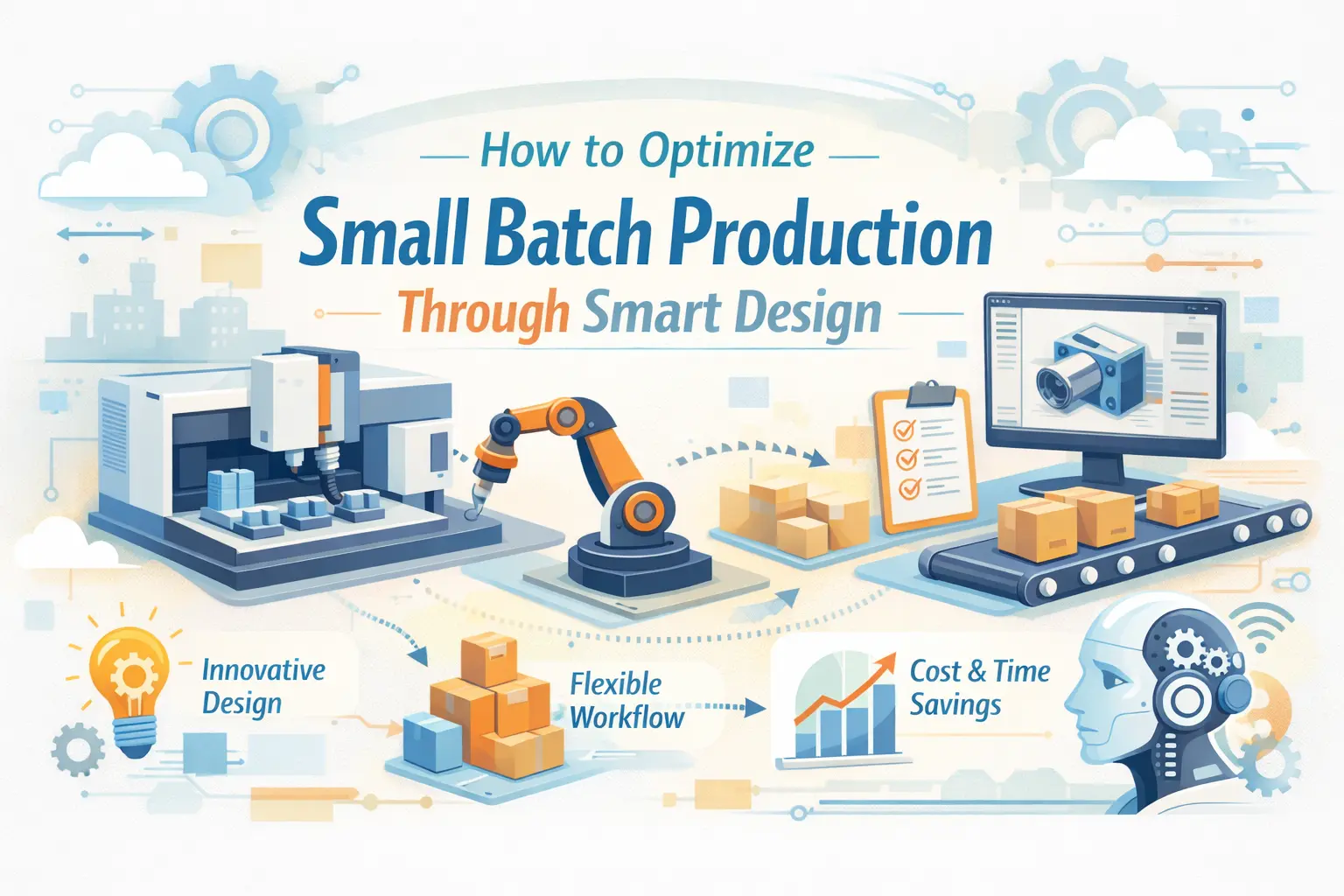
Small batch production focuses on producing limited quantities of products, offering flexibility and adaptability to market needs. However, it brings challenges, including higher per-unit costs, longer lead times, and difficulties in optimizing workflows. The design phase plays a critical role in overcoming these challenges, as smart design can simplify manufacturing processes, reduce waste, and ensure product quality. By incorporating manufacturing considerations early, engineers can create parts that are efficient to produce, cost-effective, and reliable.
The earlier manufacturability and material considerations are integrated into the design, the greater the impact on production efficiency. For small batch production, every feature, tolerance, or setup counts toward cost and lead time. Decisions made at the design stage, such as choosing simpler geometries or standard components, can reduce the need for specialized tooling and complex machining operations. This ensures that the production process remains agile and responsive, a critical advantage in small batch runs where flexibility matters more than in mass production.
Unlike mass production, small batches cannot spread tooling and setup costs over large quantities. Each unit carries a higher share of overhead, making inefficient designs costly. Tight tolerances, intricate features, and non-standard materials can dramatically increase both machining time and production complexity. Therefore, designers must anticipate manufacturing constraints and design parts that minimize unnecessary complexity while meeting performance and functional requirements.
Design for manufacturability ensures that parts are easy to produce, reducing costs and lead time in small batch production. Optimizing part geometry, tolerances, and standardization are key strategies.
Complex features such as deep pockets, undercuts, or irregular shapes often require multiple setups and special tooling. Simplifying geometry can reduce machining steps, lower the risk of errors, and shorten production cycles. For example, rounded internal corners instead of sharp ones allow easier tool access and faster cutting. Simplified geometries also make fixtures and clamping easier, improving consistency and efficiency.
While precision is necessary in critical areas, over-specifying tolerances in non-critical regions increases machining time and inspection costs. Designers should prioritize tolerances only where they affect performance or assembly. Standardizing hole sizes, threads, and feature dimensions not only reduces setup complexity but also allows for faster production with fewer mistakes.
Using commonly available fasteners, inserts, and hardware reduces the need for custom tools. Standardization also improves flexibility, making it easier to produce multiple parts with minimal setup changes. In small batch production, where each part represents a larger portion of cost, reducing custom features can significantly improve overall efficiency.
Material choice impacts machinability, cost, lead time, and product performance. Selecting the right material ensures that small batch production remains efficient and economical.
Materials should meet functional requirements without unnecessarily increasing production complexity. Aluminum and mild steel, for instance, are easier to machine than hard alloys or exotic metals. Choosing widely available stock sizes reduces sourcing time and costs. Materials that require minimal post-processing also improve workflow efficiency.
Designing parts to fit standard stock sizes and shapes reduces material waste. For cylindrical parts, selecting bar stock sizes that closely match the finished component saves scrap. Flat parts should fit standard sheet sizes whenever possible. Optimized material usage not only reduces cost but also simplifies handling and fixturing.
Durable materials that maintain dimensional stability under machining stress prevent defects and scrap, ensuring consistent quality across the batch. Poor material selection can increase tool wear, scrap rates, and lead times, all of which are critical in small batch production.
Optimizing manufacturing processes through smart design reduces setup time, machining complexity, and post-processing needs.
Design parts that can be machined in a single orientation whenever possible. Symmetrical or modular designs allow for fewer fixtures and more straightforward clamping, reducing production time. Each setup avoided is a step toward faster, more cost-effective production.
Ensure that all features are accessible without complex tool movements or multiple axes. Efficient tool paths reduce machining time and decrease the risk of errors. Features should be designed with standard tooling in mind, minimizing the need for specialized equipment.
Design components for as-machined surfaces when possible, limiting the need for finishing, polishing, or deburring. This saves labor, reduces turnaround time, and improves consistency in small batch production.
Designing for modularity and flexibility is a strategic approach to optimizing small batch production. By creating components that can be easily interchanged or adapted, manufacturers can reduce complexity, minimize inventory requirements, and streamline assembly. Modular designs allow the reuse of common elements across multiple products, which is particularly beneficial in small batch production where custom parts can quickly drive up costs. Flexibility in design also prepares manufacturers to respond to changing customer requirements or design iterations without extensive retooling.
Using modular components reduces the number of unique parts required for production. Standardized modules can be pre-manufactured and stocked, allowing for faster assembly and shorter lead times. In addition, modular components simplify inventory management because fewer distinct items need to be tracked and stored. This approach also minimizes errors in assembly, as repeatable modules reduce the chances of misalignment or incorrect installation.
Even in small batch production, the ability to scale up or modify designs is valuable. Parts that are designed with modularity in mind can be combined or adjusted to create variations without redesigning the entire system. For example, a machine housing with interchangeable panels or a bracket system with standard attachment points can accommodate different configurations or updates with minimal additional effort. This reduces production bottlenecks and allows small batches to adapt to demand fluctuations efficiently.
Incorporating symmetry and repeated features in parts can greatly simplify machining, fixturing, and inspection. Symmetrical designs often require fewer setups, and repeated features allow for batch processing rather than individual operations. For instance, multiple identical holes or slots can be drilled in a single setup, saving time and reducing the risk of errors. By leveraging symmetry and repetition, manufacturers can achieve consistent quality and lower per-unit costs, which are essential in small batch runs.
Effective collaboration between design engineers and production teams is critical to optimizing small batch production. Early and continuous communication ensures that designs are practical, manufacturable, and efficient, reducing costly mistakes and rework. Feedback from machinists and operators provides insight into potential production challenges, tool accessibility, and fixture requirements that may not be evident during the initial design phase.
Engaging CNC manufacturers early in the design process allows designers to incorporate practical production considerations. Machinists can provide guidance on tool selection, machining strategies, and fixturing requirements. Their feedback often identifies opportunities to simplify features, reduce setup time, and improve overall efficiency. Collaborative design reviews also help identify potential bottlenecks before production begins, saving both time and costs.
Small batch production benefits from iterative improvements based on real-world feedback. After an initial prototype or small run, designers can gather data on machining times, tool wear, assembly ease, and quality consistency. These insights inform refinements that make subsequent batches faster, cheaper, and more reliable. Iterative improvement ensures that the design evolves alongside production capabilities and market demands.
Simulation tools and computer-aided manufacturing (CAM) software are valuable assets for collaboration and process optimization. Virtual testing allows teams to visualize machining operations, detect potential collisions, and optimize cutting paths before physical production. This reduces trial-and-error in small batches, saving both time and material costs. By combining software simulations with hands-on feedback, manufacturers can refine designs to achieve optimal efficiency.
Cost and lead time are key metrics in small batch production, and smart design directly influences both. By simplifying designs, selecting appropriate materials, and optimizing processes, manufacturers can significantly reduce production expenses while maintaining quality. Understanding how design decisions impact setup, machining, and assembly is crucial for controlling costs in limited runs.
Every additional machining operation, fixture, or custom part increases cost. By minimizing complex features, standardizing components, and reducing tight tolerances, designers can lower production expenses. Material choice also affects cost; using widely available, machinable materials reduces both raw material expense and processing complexity. Efficient designs reduce scrap and rework, further lowering overall costs.
Small batch production often requires rapid turnaround, and design decisions have a direct effect on lead time. Fewer setups, simplified geometries, and accessible tool paths accelerate machining. Modular and symmetrical designs reduce assembly time, while standardized components eliminate delays associated with custom parts or sourcing rare materials. Together, these strategies ensure that small batches are completed quickly without compromising quality.
Overengineering, or adding unnecessary complexity and features, can inflate both cost and production time. In small batch production, it is essential to focus on essential functionality and design for manufacturability. Eliminating superfluous details reduces machining effort, simplifies inspection, and minimizes the potential for errors. Smart design balances performance requirements with practical production constraints, ensuring that resources are used efficiently.
Optimizing small batch production through smart design requires a holistic approach that integrates manufacturability, material selection, process efficiency, modularity, and collaboration. By simplifying part geometry, standardizing features, and minimizing tight tolerances, designers can reduce machining complexity and lower costs. Thoughtful material selection balances performance with ease of production, while process optimization ensures fewer setups, better tool access, and minimal post-processing. Modular and flexible designs enhance scalability, reduce inventory, and streamline assembly, while close collaboration with production teams and iterative improvement ensures practical, manufacturable outcomes.
Ultimately, smart design is the foundation of cost-effective, efficient small batch production. When design decisions prioritize manufacturability, collaboration, and process optimization, manufacturers can deliver high-quality products quickly and economically. By anticipating production challenges and incorporating feedback early, companies gain a competitive advantage, maximizing both efficiency and customer satisfaction in small batch manufacturing.
