Our Location
304 North Cardinal St.
Dorchester Center, MA 02124

304 North Cardinal St.
Dorchester Center, MA 02124

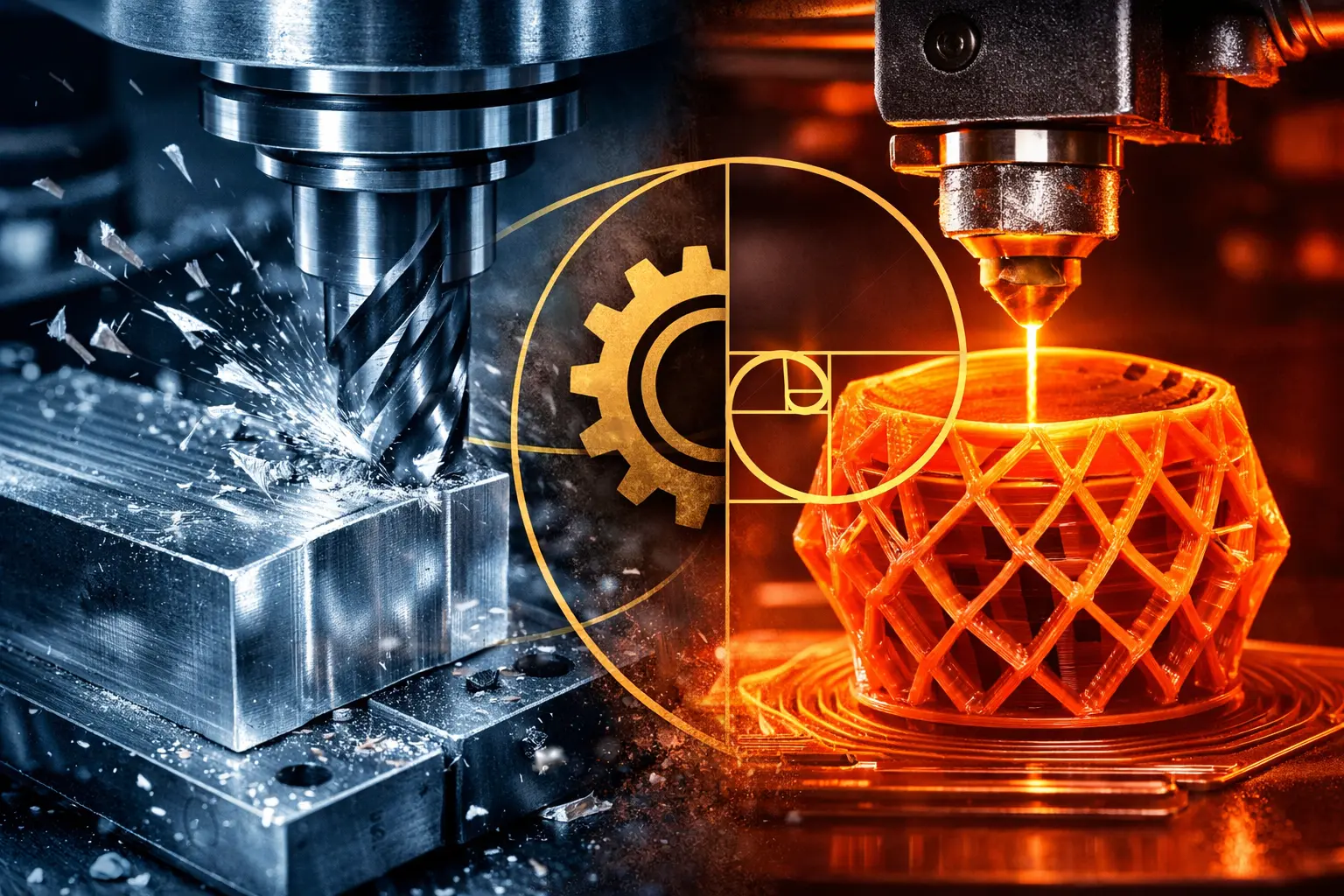
In today’s fast-paced product development environment, companies are under constant pressure to bring new ideas to market faster than ever. From early concept models to functional prototypes and final production parts, every stage of development requires speed, precision, and flexibility. Choosing the right manufacturing method plays a critical role in achieving these goals while controlling costs and maintaining product quality.
Two technologies that have transformed modern manufacturing are CNC machining and 3D printing. CNC machining is known for its high precision, excellent surface finishes, and ability to produce durable parts from a wide range of materials. In contrast, 3D printing offers unmatched speed and design freedom, making it ideal for rapid prototyping and complex geometries.
Rather than competing with each other, CNC machining and 3D printing often work best when used together. By combining the rapid iteration capabilities of 3D printing with the accuracy and strength of CNC machining, manufacturers can streamline the journey from prototype to production. This hybrid approach allows engineers to test designs quickly, refine functionality, and transition smoothly into low-volume or full-scale manufacturing.
In modern product development, speed is often a key competitive advantage. Companies that can quickly transform ideas into working prototypes and validated designs are more likely to launch products successfully. Rapid prototyping enables engineers to test functionality, identify design flaws early, and make improvements before committing to production.
Traditional manufacturing methods can be slow and expensive, especially during the early stages of development. Creating molds or specialized tooling requires significant time and investment, which makes design changes difficult and costly. For projects that require multiple design iterations, this lack of flexibility can significantly slow progress.
To overcome these challenges, many manufacturers are adopting hybrid manufacturing strategies. By combining different production technologies, such as CNC machining and 3D printing, companies can improve efficiency and flexibility throughout the development process. This approach allows designers to validate concepts quickly while still achieving the precision and durability required for functional parts.
CNC machining is a subtractive manufacturing process that uses computer-controlled machines to remove material from a solid block in order to create a finished part. The process follows a digital design file and precisely controls cutting tools to produce highly accurate components.
One of the main strengths of CNC machining is its ability to achieve tight tolerances and excellent dimensional accuracy. It also produces strong and durable parts because the components are made directly from solid materials such as aluminum, stainless steel, titanium, or engineering plastics. In addition, CNC machining delivers high-quality surface finishes that are often suitable for functional testing or final-use parts.
CNC machining is widely used for functional prototypes, engineering components, and small-batch production. It is particularly valuable in industries that require high precision and reliability, such as aerospace, automotive, medical devices, and industrial equipment.
3D printing, also known as additive manufacturing, is a process that builds parts layer by layer from a digital model. Instead of removing material like CNC machining, 3D printing adds material only where it is needed to form the final shape.
One of the biggest advantages of 3D printing is its speed and flexibility. Parts can often be produced directly from a design file without the need for molds or complex setups. This allows engineers to quickly test design concepts and make rapid modifications during development.
3D printing is particularly useful for concept models, early-stage prototypes, and components with complex geometries. It enables designers to experiment with shapes and structures that would be difficult or impossible to produce using traditional manufacturing methods.
During the early stages of product development, 3D printing allows engineers and designers to quickly produce prototypes directly from digital models. This makes it easy to evaluate the form, fit, and basic functionality of a design. If changes are required, the design can be updated and reprinted within a short time, enabling faster iteration cycles.
Once the design has been validated, CNC machining can be used to produce highly accurate and durable parts. CNC machining provides tighter tolerances, better surface finishes, and stronger material properties compared with most 3D printing methods. This makes it ideal for functional prototypes and components that need to perform under real-world conditions.
In many projects, the two technologies are used together in a structured workflow. Engineers may begin with 3D printed prototypes to test design concepts and geometry. After refining the design, CNC machining can be used to produce functional prototypes with the required precision and strength. Finally, the same CNC process can support small-batch production before moving to full-scale manufacturing if needed.
In the aerospace industry, engineers often need to test complex and lightweight structures during the development process. 3D printing enables rapid prototyping of intricate geometries, while CNC machining ensures the final components meet strict precision and strength requirements.
Automotive manufacturers frequently use hybrid manufacturing to accelerate product development. 3D printed parts can be used for early design validation, while CNC machined components provide accurate and durable prototypes for functional testing and performance evaluation.
For consumer products, both appearance and functionality are important. Designers may use 3D printing to evaluate product shape, ergonomics, and aesthetics. Once the design is finalized, CNC machining can produce high-quality prototypes that closely resemble the final manufactured parts.
When designing parts for 3D printing, engineers can take advantage of the technology’s ability to produce complex shapes, internal channels, and lightweight structures. Reducing unnecessary support structures and optimizing part orientation can also help improve printing efficiency.
CNC machining requires careful consideration of tool access and machining constraints. Designers should avoid extremely deep cavities, incorporate appropriate corner radii, and ensure that cutting tools can reach all necessary surfaces. These considerations help improve machining efficiency and reduce production costs.
To achieve the best results, manufacturers should consider the entire product development process from the beginning. Using 3D printing for rapid concept validation and CNC machining for precision prototypes creates a balanced approach that maximizes both speed and quality. By planning a hybrid strategy early in the design stage, companies can streamline development and transition smoothly from prototype to production.
WinsunProto provides both CNC machining and 3D printing services, allowing customers to move efficiently from early-stage prototypes to functional parts and small-batch production. By offering multiple manufacturing technologies in one place, the company helps streamline the development process and reduce the time required to bring products to market.
Speed and flexibility are essential in modern product development. WinsunProto supports rapid prototyping and low-volume manufacturing with quick turnaround times, making it easier for companies to test designs, refine products, and respond quickly to market demands.
With advanced equipment and experienced engineers, WinsunProto focuses on delivering high-quality parts that meet strict design specifications. The team works closely with customers to ensure that each project achieves the desired performance, accuracy, and surface quality.
In general, CNC machining offers higher dimensional accuracy and tighter tolerances than most 3D printing technologies. This makes it a better choice for precision components and functional parts that require exact measurements.
3D printing cannot completely replace CNC machining. While it is excellent for rapid prototyping and complex geometries, CNC machining is still preferred for parts that require high strength, tight tolerances, and superior surface finishes.
Many projects start with 3D printed prototypes to quickly validate the design. Once the geometry and functionality are confirmed, CNC machining is typically used to produce more precise and durable prototypes or small production runs.
Both technologies can support low-volume production depending on the requirements. 3D printing is suitable for complex or lightweight parts, while CNC machining is often preferred when strength, accuracy, and material performance are critical.
CNC machining and 3D printing each offer unique advantages in product development. While 3D printing enables rapid prototyping and design flexibility, CNC machining provides precision, strength, and high-quality surface finishes. When used together, these technologies create an efficient hybrid manufacturing approach that helps companies move smoothly from concept to production.
By combining the speed of additive manufacturing with the accuracy of subtractive machining, manufacturers can shorten development cycles, reduce costs, and improve overall product quality. Choosing the right manufacturing partner ensures that every stage of the process—from prototype to production—is handled with efficiency and reliability.
