Our Location
304 North Cardinal St.
Dorchester Center, MA 02124

304 North Cardinal St.
Dorchester Center, MA 02124

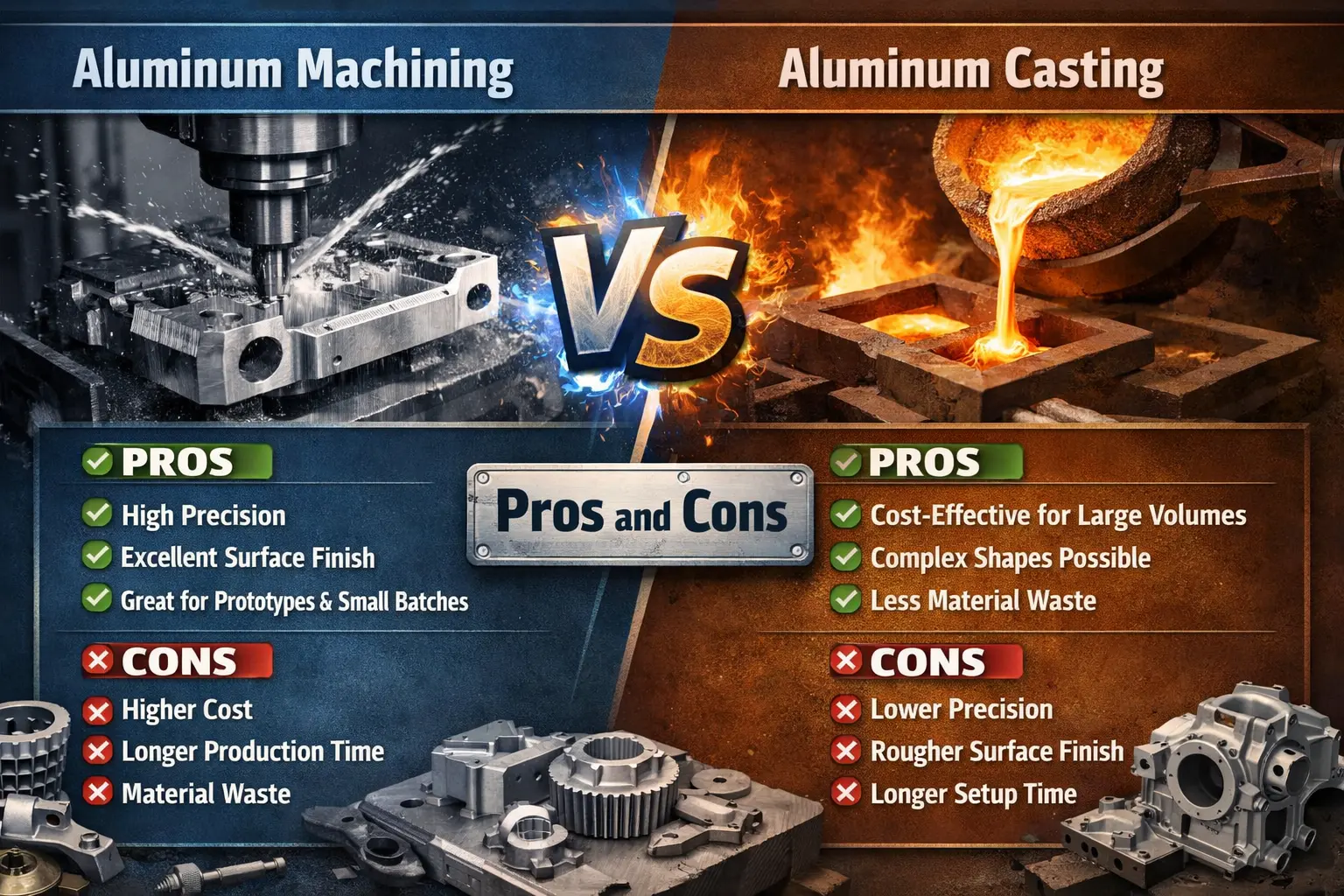
When it comes to manufacturing aluminum parts, two of the most widely used processes are CNC machining and aluminum casting. Each method offers distinct advantages, but choosing the right one can significantly impact your project’s cost, lead time, and overall quality.
For engineers, product designers, and procurement teams, the decision often comes down to a few critical factors: production volume, part complexity, tolerance requirements, and budget. Selecting the wrong process can lead to unnecessary expenses, delays, or performance issues.
In this guide, we’ll break down the key differences between aluminum machining and aluminum casting, compare their pros and cons, and help you determine the best solution for your specific application.
Aluminum machining refers to a subtractive manufacturing process in which material is removed from a solid aluminum block to create the desired part. This is typically performed using CNC (Computer Numerical Control) machines, ensuring high precision and repeatability.
Aluminum casting is a forming process where molten aluminum is poured into a mold and allowed to solidify into the desired shape. Once cooled, the part is removed and may undergo secondary finishing or machining.
CNC machining delivers exceptional accuracy, making it ideal for parts that require strict dimensional control and consistency.
Without the need for molds or tooling, machining allows for rapid production—perfect for prototyping and urgent projects.
Machined aluminum parts often come with smooth surfaces that require little to no additional finishing, reducing post-processing costs.
A wide range of aluminum alloys can be machined, enabling engineers to choose materials based on strength, weight, corrosion resistance, or performance needs.
Designs can be easily modified without incurring additional tooling costs, making machining highly adaptable during product development.
For small batches or custom components, machining is often the most cost-effective and efficient solution.
Once molds are created, casting allows manufacturers to produce large quantities of parts at a significantly lower per-unit cost compared to machining.
Casting is ideal for parts with intricate designs, internal cavities, or thin walls that would be difficult or impossible to achieve with machining alone.
Since casting uses molten aluminum poured into a mold, material utilization is higher, reducing scrap and lowering overall material costs.
Multiple features, such as ribs, bosses, and flanges, can be formed in a single cast part, reducing the need for assembly and secondary operations.
Casting is well-suited for mass production, allowing companies to meet large-scale demands efficiently.
| Factor | Aluminum Machining | Aluminum Casting |
|---|---|---|
| Initial Tooling Cost | Low (no molds required) | High (molds required) |
| Per-Part Cost (Low Volume) | Lower | Higher |
| Per-Part Cost (High Volume) | Higher | Lower |
| Material Waste | High | Low |
| Secondary Operations | Minimal | Often required for critical surfaces |
| Best Use | Prototyping, small batches | Large-scale production |
Key Takeaway:
| Factor | Aluminum Machining | Aluminum Casting |
|---|---|---|
| Setup Time | Minimal (no molds needed) | Weeks (molds need to be designed and fabricated) |
| Production Speed | Fast (ready to cut immediately) | Slower for initial batches |
| Flexibility | High (design changes easy) | Low (modifying molds is costly) |
| Overall Development Cycle | Short | Longer |
Summary:
Example Applications: Aerospace brackets, precision electronics housings, prototypes, medical devices.
Example Applications: Automotive engine components, industrial housings, mass-produced consumer products, structural parts.
Sometimes, the best solution combines casting and machining to take advantage of both processes. This hybrid approach is particularly common in industries where part complexity, precision, and production volume all matter.
Example: Automotive housings are often die-cast to form the main body, then CNC machined for bolt holes and mating surfaces.
Aluminum machining and casting are widely used across industries due to aluminum’s lightweight, strength, and corrosion resistance.
When deciding between aluminum machining, casting, or a hybrid approach, consider these factors:
| Factor | Machining | Casting | Hybrid |
|---|---|---|---|
| Volume | Low to medium | High | Medium to high |
| Tolerance | Tight | Moderate | Tight on critical surfaces |
| Design Complexity | Simple to moderate | Complex | Complex overall, precise where needed |
| Lead Time | Short | Long initial setup | Moderate |
| Cost | Low for small batches | Low per-part for high volume | Balanced cost |
Decision Tips:
At WinsunProto, we specialize in high-quality aluminum parts using CNC machining, casting, and hybrid solutions.
Q1: Is machined aluminum stronger than cast aluminum?
A: Machined aluminum retains full material density and is often stronger than cast parts, which may have porosity. However, casting allows complex shapes that may not be feasible with machining alone.
Q2: Can cast aluminum parts be machined?
A: Yes, many cast parts undergo secondary CNC machining to achieve precise dimensions and smooth surfaces.
Q3: Which process is cheaper?
A: For low-volume or prototypes, machining is usually cheaper. For high-volume production, casting offers lower per-part costs.
Q4: What alloys can be used for machining and casting?
A: Common options include 6061, 7075, 5052, and 2024, depending on strength, corrosion resistance, and machining requirements.
Q5: How fast can I get parts delivered?
A: Machined parts can be ready in days for prototyping, while casting may take weeks due to mold preparation.
Choosing the right aluminum manufacturing process is key to balancing cost, quality, and lead time.
At WinsunProto, we help you select the most efficient and cost-effective process to bring your aluminum parts from design to reality.
Ready to start your project? Contact us today to get a quote or technical guidance tailored to your needs.
