Our Location
304 North Cardinal St.
Dorchester Center, MA 02124

304 North Cardinal St.
Dorchester Center, MA 02124

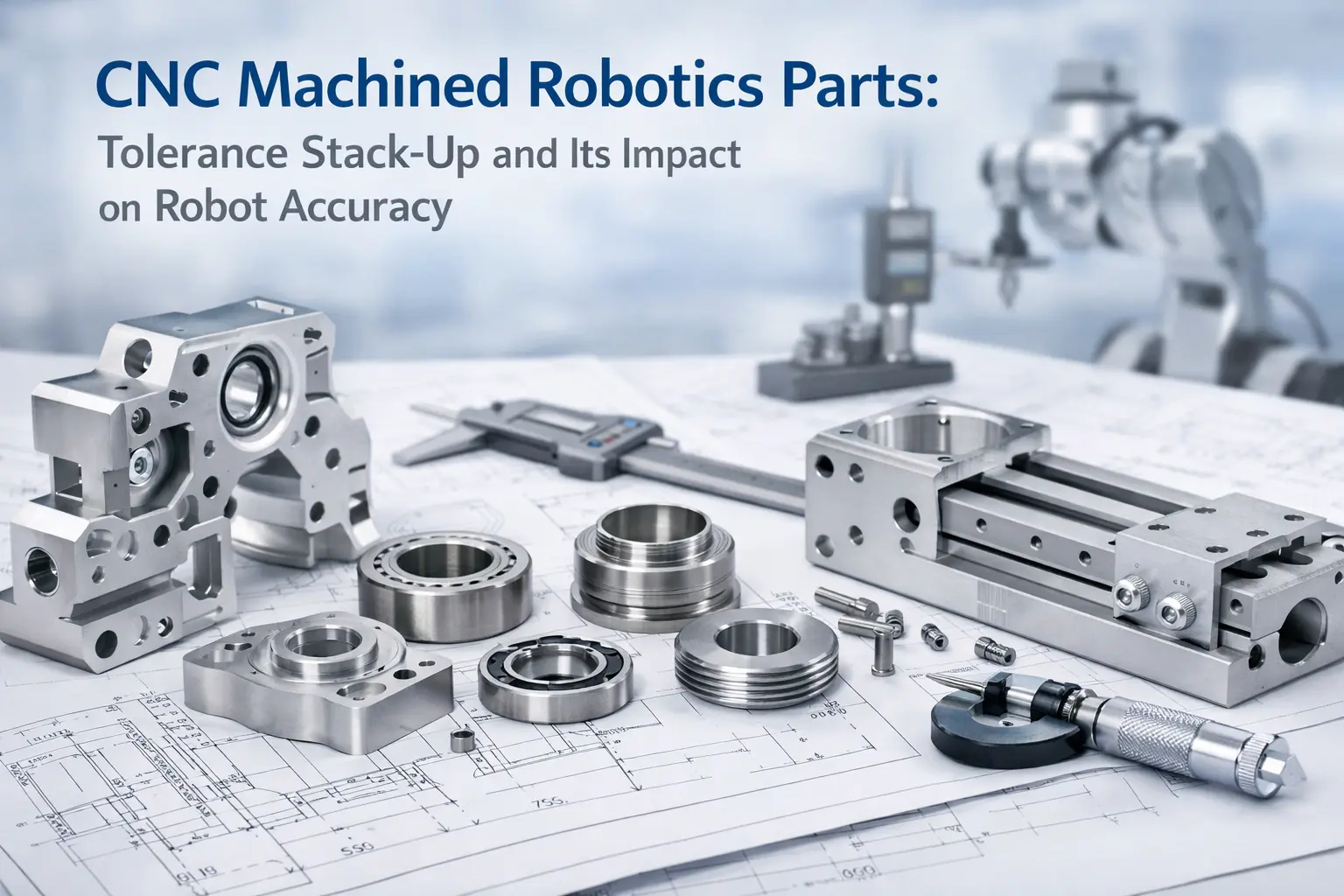
In modern robotics manufacturing, precision is not just a performance advantage—it is a fundamental requirement. Industrial robots, collaborative robots (cobots), and automated production systems all rely on extremely accurate mechanical structures to ensure stable and repeatable motion. Even a minor dimensional deviation in one component can lead to noticeable performance issues in the entire robotic system. This is why CNC machining plays a critical role in robotics part production, offering high repeatability, tight tolerances, and excellent material control across complex geometries.
However, achieving precision at the part level does not automatically guarantee accuracy at the system level. When multiple CNC-machined components are assembled into a robotic structure, small deviations begin to accumulate. This phenomenon is known as tolerance stack-up, and it often becomes the hidden factor behind positioning errors, reduced repeatability, and unexpected system instability. Understanding how tolerance stack-up develops in robotics assemblies is essential for engineers who want to improve both design reliability and manufacturing efficiency.
For deeper insight into how CNC technology is applied in robotics component production, you can also refer to this related guide: https://winsunproto.com/cnc-machining-for-robotics/
Tolerance stack-up refers to the cumulative effect of small dimensional variations that occur in individual parts within an assembly. In CNC machining, every feature is produced within a defined tolerance range, such as ±0.01 mm or tighter. While each part may independently meet its specification, the combination of multiple parts can create a larger overall deviation than expected. This accumulation becomes especially critical in robotics systems, where mechanical precision directly affects motion accuracy and control stability.
In robotic assemblies, tolerance stack-up is not limited to simple linear measurements. Instead, it often involves complex geometric relationships across multiple axes and rotational joints. A robotic arm, for example, consists of several interconnected links, bearings, shafts, and mounting interfaces. Each interface introduces potential deviation in position and orientation. As these small errors propagate through the kinematic chain, they can significantly affect the final tool center point (TCP), especially in long-arm or multi-axis systems.
One of the most misunderstood aspects of CNC manufacturing is that individual part compliance does not guarantee assembly success. A component may fall perfectly within its tolerance range, yet still contribute to system-level misalignment when combined with other parts. This occurs because tolerances do not cancel out—they accumulate. In robotics systems, this can lead to subtle but critical issues such as uneven motion paths, poor alignment between joints, or reduced end-effector accuracy. This is why system-level tolerance analysis is just as important as part-level inspection.
CNC machining is widely used in robotics because of its ability to achieve high precision and repeatability. Standard machining tolerances in industrial applications often range from ±0.01 mm to ±0.005 mm, depending on machine capability, tooling, and material. However, robotics applications often demand even tighter tolerances, particularly for components such as joint housings, bearing seats, and precision alignment features. In some high-end systems, micron-level accuracy is required to ensure smooth and predictable motion behavior.
Geometric Dimensioning and Tolerancing (GD&T) plays a crucial role in defining functional accuracy in robotics parts. Unlike traditional dimensional tolerancing, GD&T focuses on how features behave in relation to each other. It controls critical geometric characteristics such as flatness, perpendicularity, concentricity, and positional accuracy. In robotics manufacturing, GD&T ensures that parts not only fit together but also function correctly under dynamic motion conditions. Proper datum selection is especially important, as it establishes a consistent reference framework for all measurements.
Even with advanced CNC equipment, dimensional variation is unavoidable. Several factors contribute to this variation, including tool wear, cutting force deformation, thermal expansion during machining, and fixture instability. Programming errors or suboptimal toolpaths can also introduce inconsistencies. In robotics part manufacturing, where precision is critical, even small variations from these sources can accumulate into noticeable system-level inaccuracies when multiple components are assembled together.
Robotic systems are built from multiple interconnected mechanical elements, including base structures, rotating joints, link arms, gear systems, and end-effectors. Each of these components forms part of a larger kinematic chain, where movement in one section directly affects all downstream sections. Because of this dependency, even slight dimensional deviations at one interface can propagate throughout the entire system. This makes robotics assemblies far more sensitive to tolerance issues compared to simple static mechanical structures.
As a robot moves, each joint and linkage introduces a small positional deviation based on manufacturing tolerances. These deviations may seem insignificant at the individual level, but they accumulate along the kinematic chain. For example, a minor angular error at a shoulder joint can result in several millimeters of deviation at the end-effector. This effect becomes more pronounced in long-reach robotic arms or systems with multiple rotational axes, where compounded errors can significantly reduce accuracy.
In industrial applications such as welding, assembly, or pick-and-place operations, accuracy at the tool center point is critical. If tolerance stack-up causes even slight deviations, the robot may fail to position tools correctly, leading to misaligned welds, incorrect assembly placement, or reduced product quality. Over time, these small errors can result in increased rework, higher scrap rates, and reduced production efficiency, highlighting the importance of precision engineering in robotics manufacturing.
One of the most direct consequences of tolerance stack-up is the reduction in end-effector positioning accuracy. The tool center point may deviate from its intended path due to accumulated dimensional errors across multiple joints and components. This issue becomes especially critical in applications requiring high precision, such as micro-assembly, laser cutting, or surgical robotics, where even sub-millimeter deviations can lead to functional failure.
While accuracy refers to reaching the correct position, repeatability refers to the robot’s ability to consistently return to the same position. Tolerance stack-up negatively affects both. As errors accumulate, mechanical inconsistencies can introduce variability in repeated operations. This reduces system stability and increases the need for frequent recalibration, particularly in high-cycle production environments.
Modern robotic systems often rely on software compensation to correct mechanical imperfections. However, when tolerance stack-up becomes too significant, software correction alone is not sufficient. Motion paths may still deviate from their intended trajectories, requiring more complex control algorithms and sensor feedback systems. This increases system complexity and cost while still not fully eliminating mechanical inaccuracies.
Ultimately, tolerance stack-up has a direct impact on production efficiency and manufacturing cost. Poorly controlled tolerances can lead to increased defect rates, higher scrap levels, and reduced throughput in automated systems. In high-volume production environments, even small inefficiencies can accumulate into significant financial losses, making tolerance control a critical factor in robotics system design and CNC manufacturing strategy.
One of the most important factors affecting tolerance stack-up is the number of components in a robotic system. The more parts involved in an assembly, the more interfaces exist where dimensional variation can occur. Each interface—whether it is a bolted joint, press-fit bearing, or sliding connection—adds another layer of potential deviation. In complex robotic arms with multiple degrees of freedom, this becomes a significant engineering challenge. Even if each individual component is manufactured within acceptable limits, the cumulative effect across dozens of interfaces can lead to measurable accuracy loss at the end-effector.
Effective tolerance management begins at the design stage. Engineers must decide how to distribute tolerances across different components based on their functional importance. Critical features such as bearing seats, alignment pins, and actuator mounts typically require tighter tolerances, while non-critical surfaces can allow looser specifications. Poor tolerance allocation often leads to unnecessary manufacturing cost without improving system performance, while well-optimized allocation reduces both cost and stack-up risk.
Material selection also plays a major role in tolerance behavior. Different metals and alloys expand at different rates when exposed to temperature changes. In robotics systems that operate continuously or in variable environments, thermal expansion can introduce additional dimensional shifts beyond manufacturing tolerances. For example, aluminum structures may expand more than steel components, leading to slight misalignments under operating conditions. These effects must be considered during both design and material selection stages.
Different CNC machining processes provide different levels of precision and stability. Standard 3-axis milling may be sufficient for general components, but complex robotic parts often require 5-axis machining to maintain tighter geometric control. Turning processes are typically used for rotational parts such as shafts and bearings, where concentricity is critical. The choice of machining method directly influences achievable tolerance consistency and therefore affects overall stack-up behavior in the final assembly.
One of the most effective ways to control tolerance stack-up is through proper use of GD&T principles. Instead of relying on simple ± dimensional tolerances, engineers define functional relationships between features. This ensures that parts are manufactured based on how they function in the assembly rather than just their individual dimensions. By controlling orientation, position, and form more precisely, GD&T reduces ambiguity and improves assembly reliability.
A stable datum system is essential for ensuring repeatable accuracy in robotics assemblies. Datums serve as reference points for all measurements and alignments within a part. When properly designed, they ensure that all components align consistently during assembly, reducing variation between batches. Poor datum design, on the other hand, can lead to misalignment even when all parts are within tolerance.
Not all dimensions in a robotic component are equally important. Engineers must identify critical functional dimensions that directly affect performance and prioritize them for tighter control. This approach avoids over-engineering non-essential features while focusing manufacturing precision where it matters most. It also helps reduce production cost without sacrificing system accuracy.
Modular design strategies help break down complex robotic systems into smaller, independently controlled subassemblies. Instead of allowing errors to accumulate across a long kinematic chain, each module is optimized and tested separately. This approach reduces overall stack-up risk and makes it easier to control quality at each stage of production.
Advanced inspection technologies such as Coordinate Measuring Machines (CMM) play a crucial role in verifying machining accuracy. By measuring components at high precision levels, manufacturers can detect deviations before assembly. This feedback loop allows for process adjustments that reduce variation over time, improving both consistency and reliability in mass production.
Design for Manufacturing ensures that robotic components are designed with machining capabilities in mind. By considering tool accessibility, machining constraints, and fixture requirements early in the design phase, engineers can significantly reduce tolerance-related issues during production. This alignment between design and manufacturing improves both cost efficiency and accuracy.
Modern engineering tools allow simulation of tolerance stack-up before physical production begins. These simulations model how individual part variations affect overall assembly performance. By identifying high-risk tolerance chains early, engineers can adjust designs to minimize potential error accumulation, reducing costly redesigns later in production.
Maintaining consistent machining conditions is critical for reducing variation between parts. This includes stable machine calibration, controlled environmental conditions, and standardized tooling procedures. Even small inconsistencies in production settings can lead to variation that compounds across large-scale robotic assemblies.
A strong quality assurance system ensures that deviations are detected early in the production process. This includes in-process inspection, final part verification, and statistical process control (SPC). By continuously monitoring production quality, manufacturers can maintain tighter tolerance control across entire production batches.
Industrial robots used in manufacturing lines require high precision and repeatability to perform tasks such as welding, assembly, painting, and material handling. In these systems, tolerance stack-up directly affects productivity and product quality. Even small deviations can lead to misalignment in high-speed production environments.
Medical robots demand extremely high accuracy due to the sensitivity of surgical procedures. In these systems, even sub-millimeter errors caused by tolerance stack-up can have serious consequences. Therefore, ultra-precision CNC machining and strict tolerance control are essential for safety and performance.
Cobots are designed to work alongside humans and must balance precision with safety. While they may not always require extreme precision, consistency and repeatability are still critical. Tolerance stack-up must be carefully controlled to ensure smooth interaction and predictable behavior in shared workspaces.
In industries such as semiconductor manufacturing and precision electronics, robotic systems must operate at extremely high accuracy levels. Tolerance stack-up control is essential to maintain product quality in processes such as wafer handling, micro-assembly, and inspection automation.
Tolerance stack-up is one of the most critical yet often overlooked factors in robotics manufacturing. While individual CNC-machined parts may meet their specifications, the interaction between multiple components can significantly impact overall system accuracy. Understanding how tolerances accumulate allows engineers to design more reliable, efficient, and cost-effective robotic systems.
Ultimately, achieving optimal performance is not about eliminating all tolerances but about controlling and distributing them intelligently. By combining GD&T principles, smart design strategies, precise CNC machining, and rigorous quality control, manufacturers can achieve a balanced system where precision, cost, and manufacturability coexist effectively. This is especially important in modern robotics applications, where both performance and scalability are key to success.
