Our Location
304 North Cardinal St.
Dorchester Center, MA 02124

304 North Cardinal St.
Dorchester Center, MA 02124

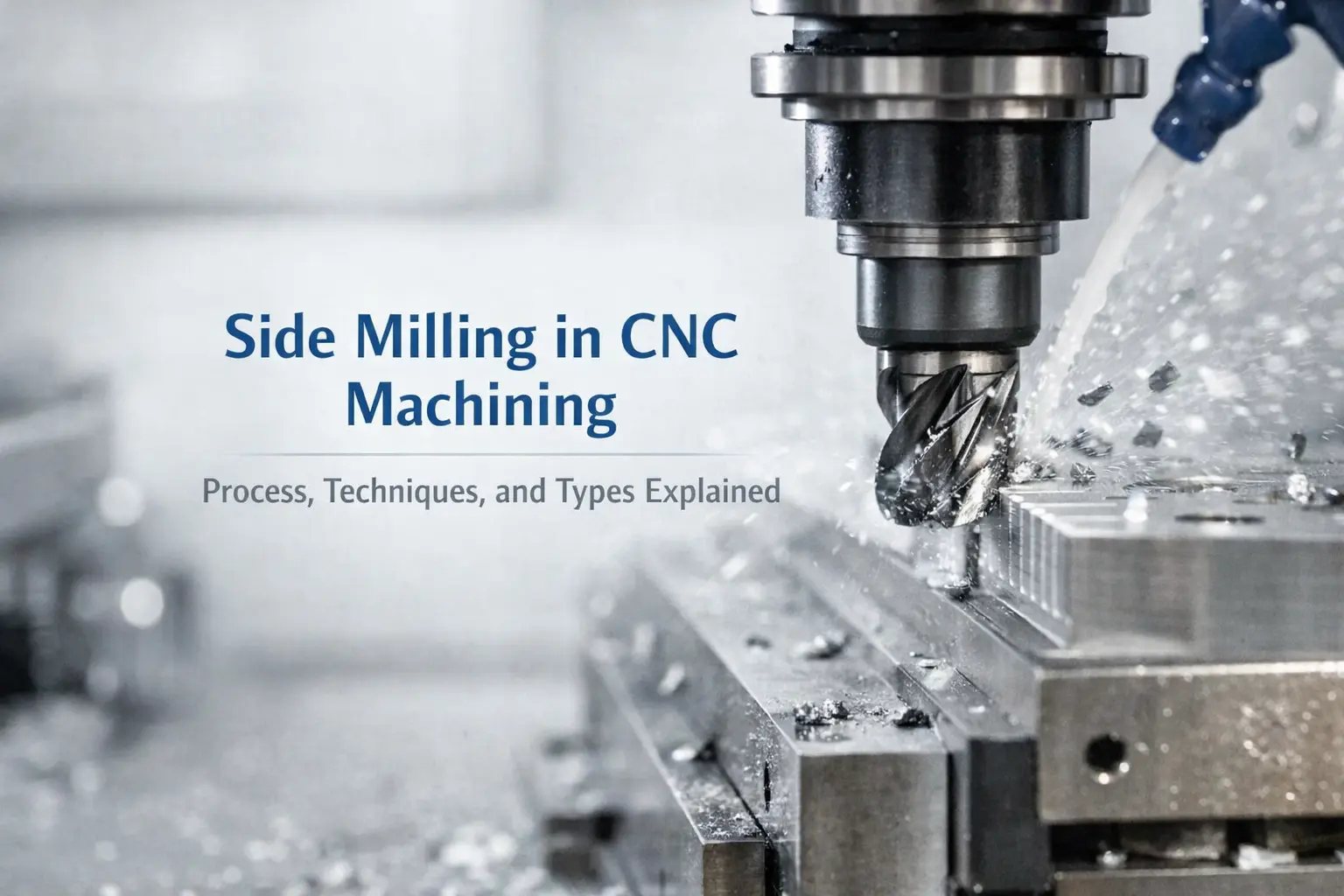
Side milling is one of the most fundamental yet versatile processes in CNC machining. Unlike end milling, which primarily engages the tool tip, side milling uses the cutter’s side edges to remove material. This allows precise machining of flat surfaces, slots, and complex profiles while maintaining high surface quality and tight dimensional tolerances. Industries like aerospace, automotive, and mold making heavily rely on side milling for both roughing and finishing operations.
Side milling is critical in CNC because it balances material removal efficiency with precision. It enables machining of large, flat surfaces where end milling might be inefficient, and allows for the creation of grooves, steps, and angular surfaces. Using the correct technique can reduce cycle time, minimize tool wear, and improve surface quality. If you want to understand more general milling concepts, see our Plain Milling Complete Guide to Process, Tools, and Applications.
Side milling finds applications across multiple industries. In automotive, it machines engine blocks and chassis components; in aerospace, it produces fuselage panels and wing spars; in electronics and medical device manufacturing, it ensures precise slotting and surface finishing of small components. The versatility and efficiency of side milling make it a core skill for CNC operators and process engineers, contributing to cost savings and higher productivity in manufacturing.
Choosing the right cutter is the first step. Side milling typically uses side and face mills, slab mills, or form cutters. Side and face mills offer multiple cutting edges for high material removal rates. Cutter material—HSS, carbide, or coated variants—affects cutting performance and tool longevity. Proper selection is essential for balancing efficiency and quality.
Secure workholding is critical because side milling generates lateral forces that can cause vibration or deflection. CNC operators must optimize spindle speed, feed rate, and depth of cut. Too aggressive a depth can induce chatter; too shallow reduces efficiency. Modern CNC machines use CAM software to simulate operations and optimize toolpaths, as explained in our CNC Turning vs. Milling Complete Comparison and Practical Guide.
Side milling produces smooth surfaces due to side-edge engagement, making it ideal for achieving tight tolerances. Multiple passes can be used to refine surface finish. Proper lubrication and cooling are essential to prevent heat buildup, which affects tool life and part quality. The process can adapt to different materials, from soft aluminum to hardened steel, with careful adjustment of cutting parameters and tool geometry.
Side milling can be performed using climb milling (down milling) or conventional milling (up milling). Climb milling reduces tool wear and improves surface finish by cutting in the direction of feed. Conventional milling is more forgiving for machines with lower rigidity but generates higher heat and potential chatter. Selecting the right strategy is key for efficiency and part quality.
Toolpath strategies—zigzag, contour, and trochoidal—affect efficiency, tool load, and surface finish. Zigzag paths excel in roughing large surfaces, contour passes are ideal for finishing edges, and trochoidal milling reduces peak tool load, extending cutter life for hard materials. Proper toolpath planning is essential for both quality and productivity.
Monitoring tool wear, selecting proper cutter diameter and flute count, and applying coatings such as TiN or TiAlN enhance tool life. Multiple finishing passes with reduced depth of cut help achieve smooth surfaces and tight tolerances. Adequate lubrication, coolant, and chip removal prevent defects. Following these best practices ensures consistent results and operational efficiency.
Plain side milling is the most common form of side milling and involves using a single cutter or multiple cutters to remove material from flat surfaces. In this technique, the cutter’s side edges are fully engaged with the workpiece, which allows for efficient material removal over a large area. This method is ideal for creating wide, flat surfaces, such as base plates, panels, and structural components in automotive or aerospace applications. One of the key advantages of plain side milling is its versatility; it can handle both roughing and finishing operations depending on the depth of cut and feed rate. Tool selection is critical—using a side and face mill with multiple flutes ensures high productivity and consistent surface quality. Operators must also account for cutting forces, as the lateral engagement can produce deflection if the workpiece or machine setup is not sufficiently rigid. Proper lubrication and coolant flow are necessary to prevent overheating and maintain tool life. For a broader understanding of surface milling processes, see our Plain Milling Complete Guide to Process, Tools, and Applications.
Straddle milling involves using two or more cutters mounted on the same arbor to machine parallel surfaces simultaneously. This type of milling is particularly effective for machining grooves, ribs, or features that require precise spacing. By engaging multiple cutters, straddle milling reduces setup time and ensures consistent dimensional accuracy across parts. Form milling, on the other hand, uses specially shaped cutters to produce complex profiles, contours, or curved surfaces. This method is essential for parts requiring intricate geometry, such as molds, dies, and aerospace components. Both straddle and form milling demand careful planning of cutting parameters and toolpaths. Operators must consider factors such as cutter diameter, number of teeth, and material hardness to minimize tool deflection and vibration. CAM software is often employed to simulate these complex operations, optimize tool engagement, and prevent collisions, improving both efficiency and safety. The combination of straddle and form milling techniques allows CNC manufacturers to achieve high precision and repeatability in complex parts.
Angular side milling is a technique in which the cutter is mounted at a specific angle to the workpiece, allowing the creation of beveled edges, chamfers, or angled surfaces. This type of milling is widely used in mechanical components, molds, and die-making, where precise angular features are required. Specialized variants of side milling include high-speed side milling for lightweight materials, trochoidal side milling for hard metals, and multi-axis side milling for intricate 3D surfaces. Each variant requires careful consideration of tool geometry, feed rate, and cutting speed to maintain surface quality and dimensional accuracy. Using modern CNC machines and simulation tools, manufacturers can optimize these advanced side milling processes, reducing cycle time while maintaining high precision. By selecting the appropriate type of side milling for the application, manufacturers can enhance production efficiency, achieve superior surface finishes, and extend tool life, ultimately reducing manufacturing costs and improving part quality. For insights on CNC machining optimization and comparisons with turning operations, refer to our CNC Turning vs. Milling Complete Comparison and Practical Guide.
Side milling is widely used in the automotive industry due to its ability to produce large, precise surfaces and complex geometries efficiently. Engine blocks, transmission housings, chassis components, and structural brackets often require both flat surfaces and grooves that side milling can deliver with high accuracy. The process ensures dimensional consistency across multiple parts, which is essential for assembly line operations. In addition, side milling allows manufacturers to reduce finishing operations, lowering production time and cost. By combining climb and conventional milling strategies and selecting appropriate cutter geometries, automotive CNC shops can achieve superior surface finishes and extend tool life. For more on basic milling processes used in automotive part production, see our Plain Milling Complete Guide to Process, Tools, and Applications.
The aerospace industry demands extremely tight tolerances and high-quality surface finishes, making side milling an indispensable process. Components such as wing spars, fuselage panels, engine mounts, and structural brackets are often machined from high-strength alloys like titanium or aluminum. Side milling allows for precise control of flatness, parallelism, and surface integrity across large components. High-speed side milling and multi-axis operations further enhance productivity by enabling complex part geometries to be machined in fewer setups. The combination of advanced CNC programming, toolpath simulation, and careful selection of cutter materials ensures both efficiency and reliability. Aerospace manufacturers rely on side milling to reduce weight, maintain structural integrity, and meet stringent regulatory standards.
In mold and die-making, side milling provides the accuracy and surface finish needed for high-precision cavities and core features. By using form milling and angular side milling techniques, complex mold profiles can be achieved with minimal finishing. Similarly, in electronics and medical device manufacturing, side milling allows precise slotting, chamfering, and surface finishing on small yet critical components. These industries benefit from reduced setup times and enhanced repeatability when side milling is applied properly. Toolpath optimization and the use of advanced cutters prevent issues like chatter or burr formation, ensuring parts meet exacting specifications. For a deeper understanding of CNC machining techniques applicable across industries, our CNC Turning vs. Milling Complete Comparison and Practical Guide provides practical insights into optimizing processes for different materials and part geometries.
Side milling remains a cornerstone of CNC machining because it balances material removal efficiency, surface quality, and precision. By engaging the cutter’s side edges, the process produces smooth surfaces, consistent tolerances, and high repeatability across diverse applications. It offers flexibility in handling various materials, from soft aluminum to hardened steel, while accommodating complex geometries that would be difficult to achieve with end milling alone. Efficient toolpath strategies, proper cutter selection, and optimal cutting parameters reduce cycle times and extend tool life, making side milling a cost-effective solution for high-volume production.
Successful side milling requires careful planning of cutter type, workpiece setup, feed rate, spindle speed, and depth of cut. Operators should leverage modern CNC simulation software to validate toolpaths, prevent collisions, and optimize cutting conditions. Maintenance of cutting tools, machine calibration, and proper workholding are essential to minimize vibration and achieve precise dimensional accuracy. Applying techniques like climb or conventional milling strategically can further enhance surface finish and productivity. Best practices also include monitoring tool wear, proper lubrication, and using finishing passes to meet exacting tolerances.
As CNC technology evolves, side milling continues to adapt with multi-axis machining, high-speed cutting, and advanced materials. Its ability to efficiently produce complex shapes with superior surface quality ensures it will remain integral to automotive, aerospace, mold making, and medical device industries. Mastery of side milling not only improves manufacturing efficiency but also supports innovation in product design and production processes. For those seeking deeper insights into CNC machining and milling techniques, our Plain Milling Complete Guide and CNC Turning vs. Milling Guide offer comprehensive resources for practical application and process optimization.
