Our Location
304 North Cardinal St.
Dorchester Center, MA 02124

304 North Cardinal St.
Dorchester Center, MA 02124

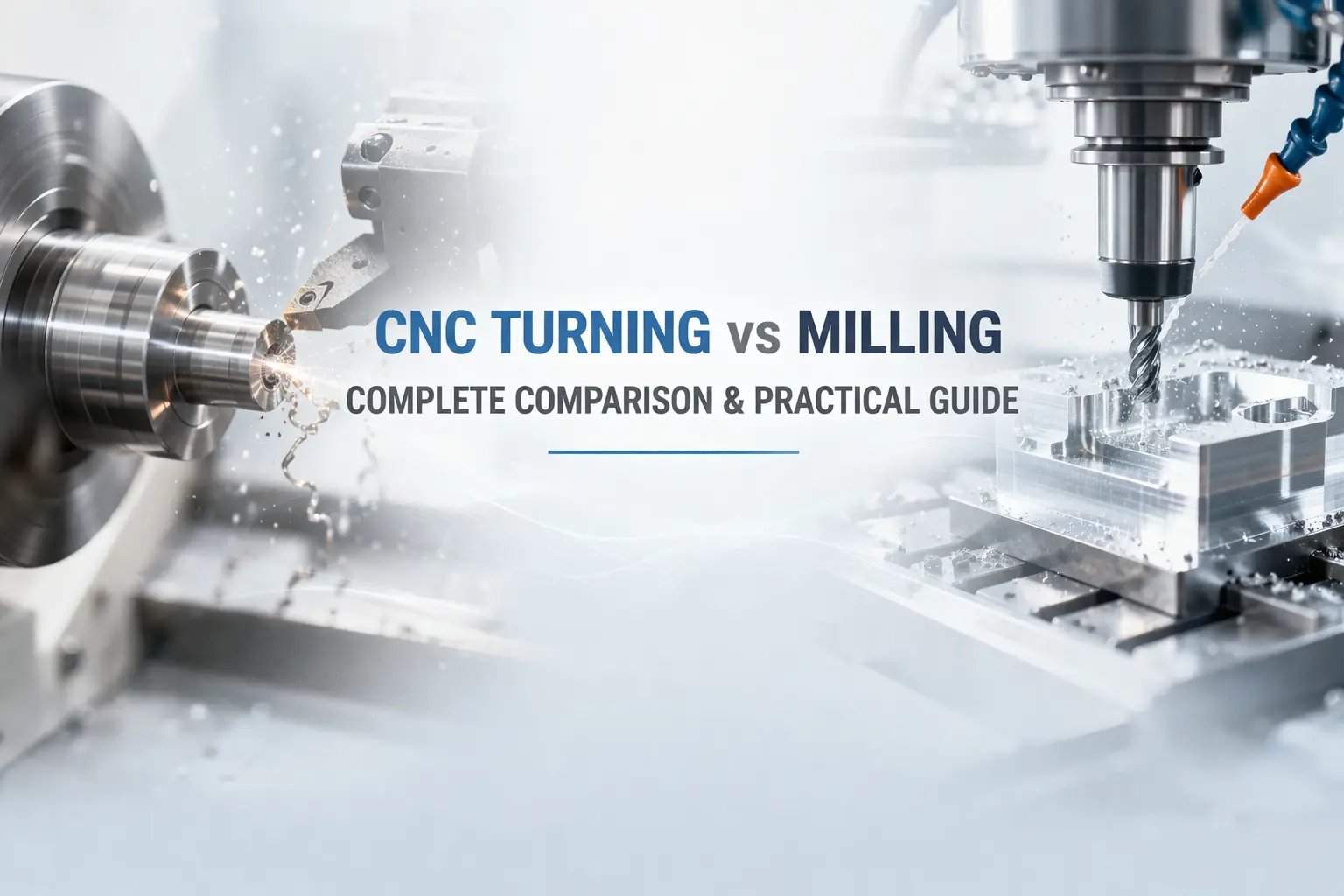
CNC machining has revolutionized modern manufacturing, enabling companies to produce high-precision parts with exceptional efficiency. Unlike traditional manual machining, CNC—or Computer Numerical Control—machines automate the movement of cutting tools or workpieces based on pre-programmed instructions. This automation not only enhances accuracy and repeatability but also allows for complex geometries that were once impossible to achieve with manual processes. As industries such as aerospace, automotive, medical devices, and electronics demand higher precision and tighter tolerances, understanding the differences between CNC Turning and CNC Milling becomes crucial for engineers, designers, and production managers.
CNC Turning and Milling are two fundamental machining processes, each optimized for specific types of components and geometries. CNC Turning, often referred to as lathe machining, involves rotating the workpiece while a stationary cutting tool removes material. This process is ideal for cylindrical and symmetrical parts, such as shafts, pins, and threaded components. In contrast, CNC Milling rotates the cutting tool against a stationary workpiece, making it suitable for flat surfaces, complex contours, and intricate pockets. Both processes rely on precise motion control, advanced tooling, and sophisticated programming to achieve desired specifications.
Selecting the appropriate process can significantly impact production efficiency, part quality, and overall cost. For instance, using CNC Milling for a simple cylindrical rod could be inefficient and more expensive than turning it on a lathe. Conversely, attempting to turn a complex multi-surfaced component could lead to excessive setups and extended machining time, making milling or a hybrid mill-turn solution more practical. By understanding the operational principles, advantages, limitations, and typical applications of CNC Turning and Milling, manufacturers can make informed decisions that optimize both performance and cost-effectiveness.
Moreover, CNC Turning and Milling are often complementary in advanced manufacturing. Many modern facilities employ hybrid machines that combine turning and milling capabilities, allowing multiple operations in a single setup. This integration reduces handling, improves alignment accuracy, and minimizes production lead time. For manufacturers aiming to streamline workflows while maintaining high-quality output, knowledge of both processes is indispensable.
For readers seeking deeper insight, a detailed guide to CNC Turning can be found here: CNC Turning: The Complete Guide to Precision Machined Components. Similarly, a comprehensive guide to CNC Milling is available at CNC Milling: The Complete Guide to Precision Milling Services. Both resources provide step-by-step explanations, practical tips, and real-world applications to help manufacturers and engineers optimize their CNC operations.
In summary, the importance of CNC Turning and Milling in modern production cannot be overstated. Each process offers unique advantages that suit specific design requirements and material considerations. By mastering these processes and understanding when and how to apply them, manufacturers can achieve precision, efficiency, and cost savings, ultimately enhancing competitiveness in highly demanding markets. Whether producing high-volume automotive parts, precision aerospace components, or custom medical devices, a solid understanding of CNC Turning and Milling serves as a foundation for successful manufacturing operations.
CNC Turning, commonly performed on a lathe, is a subtractive manufacturing process where the workpiece rotates against a stationary cutting tool. The fundamental principle involves material removal along the workpiece’s circumference to achieve precise diameters, lengths, and surface finishes. The cutting tool can move linearly along two main axes: the X-axis (radial movement) and the Z-axis (axial movement). More advanced CNC lathes may include additional axes or live tooling, allowing milling, drilling, or threading operations without transferring the part to another machine.
Turning is particularly efficient for producing cylindrical or rotationally symmetrical components, including shafts, bushings, pins, and threaded fasteners. The rotational motion allows for consistent material removal and high surface finish, which is essential in high-precision applications. Key process variables include spindle speed, feed rate, depth of cut, and tool geometry. Selecting the appropriate cutting parameters is crucial to prevent tool wear, minimize vibration, and achieve desired tolerances.
CNC Turning is also advantageous for high-volume production, as lathes can maintain consistent dimensions across large batches. Automated bar feeders can load raw material directly into the spindle, enabling continuous operation with minimal human intervention. This level of automation ensures repeatability and reduces the risk of human error, making turning an ideal solution for industries that demand uniformity and quality, such as automotive and aerospace manufacturing.
For those seeking a complete guide to CNC Turning, including practical tips for tool selection, material considerations, and advanced multi-axis operations, you can explore: CNC Turning: The Complete Guide to Precision Machined Components.
CNC Milling is another critical subtractive manufacturing process where a rotating cutting tool removes material from a stationary workpiece. Unlike turning, the workpiece remains fixed while the tool moves across multiple axes to shape the component. Milling machines can be simple 3-axis machines or more complex 4-axis and 5-axis machines that allow for simultaneous multi-directional machining. This versatility makes milling ideal for complex geometries, including pockets, slots, holes, and contoured surfaces.
Milling operations can be categorized into face milling, peripheral milling, slotting, drilling, and contouring. Each operation requires precise programming and tooling selection to achieve the desired surface finish and dimensional accuracy. Cutting parameters such as spindle speed, feed rate, and tool engagement depth must be carefully optimized to balance productivity and tool life. Milling is particularly effective for components with multiple features on different faces, where turning alone would require multiple setups or be impossible to execute.
In addition to producing flat and complex shapes, CNC Milling supports advanced applications such as 3D contouring and aerospace components with tight tolerances. By combining multiple operations in a single program, milling reduces setup time, ensures consistent part quality, and allows manufacturers to produce intricate designs with high repeatability. Industries that rely heavily on CNC Milling include automotive, medical device manufacturing, electronics, and tooling production.
For an in-depth understanding of CNC Milling, including process optimization, material compatibility, and multi-axis machining, see: CNC Milling: The Complete Guide to Precision Milling Services.
While both processes are CNC-based and achieve high precision, the primary distinction lies in the movement of the tool and workpiece. Turning rotates the workpiece against a stationary cutting tool, making it ideal for cylindrical geometries. Milling rotates the cutting tool against a stationary workpiece, providing flexibility for flat surfaces and complex multi-face features. Other differences include machine complexity, axis availability, cutting strategies, and typical applications.
Understanding these basic concepts is essential for selecting the right process for your manufacturing needs. Making an informed choice ensures optimal efficiency, reduced costs, and high-quality output, which are critical in competitive industries.
CNC Turning and Milling differ fundamentally in their material removal approach. Turning uses a rotational movement of the workpiece, with the cutting tool advancing linearly along the part’s surface. This approach allows precise control over diameters, shoulder lengths, grooves, and threads. Milling, on the other hand, rotates the cutting tool and moves it along multiple axes against a stationary workpiece. This enables the creation of complex features such as pockets, slots, and contours that would be challenging or impossible to produce with turning alone.
The choice of motion and material removal strategy also impacts cycle time, surface finish, and tool wear. Turning excels at high-speed production of symmetrical parts, while milling provides versatility for multi-featured, irregular shapes.
CNC Turning machines typically operate along two main axes—X (radial) and Z (axial)—though advanced lathes with live tooling may include additional axes. Milling machines range from simple 3-axis setups to advanced 5-axis configurations, allowing simultaneous multi-directional machining. This difference in machine capabilities directly affects the types of components each process can efficiently produce.
Turning is the preferred choice for components with rotational symmetry, such as shafts, bushings, and pins, particularly in high-volume production. Milling is better suited for components with multiple faces, flat surfaces, or complex 3D contours. In some cases, hybrid Mill-Turn machines can combine the advantages of both processes, reducing setup times and improving alignment for complex parts.
Both turning and milling can achieve high precision, but the nature of the part influences achievable tolerances. Turning generally produces excellent concentricity and smooth surface finishes for cylindrical parts, while milling allows intricate feature machining with precise flatness and positional tolerances. Tool selection, feed rates, and cutting strategies are critical in achieving the desired quality in both processes.
One of the most critical differences between CNC Turning and Milling lies in the geometries each process can efficiently produce. CNC Turning excels in creating cylindrical, conical, or rotationally symmetrical parts. Components like shafts, bushings, pins, spindles, and threaded rods are best suited for turning because the cutting tool can consistently remove material along the circumference of a spinning workpiece. The rotational motion ensures high dimensional accuracy and smooth surface finishes, which are essential in applications requiring precise fits, such as automotive transmissions, aerospace components, and industrial machinery.
CNC Milling, in contrast, is designed for more complex geometries. By moving the cutting tool across multiple axes, milling machines can produce flat surfaces, angled features, slots, pockets, holes, and even intricate 3D contours. Multi-axis milling allows manufacturers to machine multiple faces of a part in a single setup, reducing errors from repeated handling. Milling is particularly effective for components like brackets, housings, molds, aerospace panels, and medical implants, where intricate features and multi-surface machining are required. The flexibility of milling makes it ideal for prototyping, custom designs, and low-to-medium volume production with complex shapes.
Both CNC Turning and Milling offer exceptional precision, but the type of part and machining strategy influence achievable tolerances and surface quality. Turning provides excellent concentricity and roundness, making it ideal for parts that require smooth cylindrical surfaces. Tool geometry, cutting speed, and feed rate are carefully optimized to maintain surface finishes often as low as Ra 0.4–0.8 µm. Milling, while versatile, may require careful selection of cutting tools and spindle speed to achieve similar surface finishes on flat or contoured surfaces. Advanced milling operations with high-speed spindles and precise toolpaths can produce tolerances as tight as ±0.01 mm, suitable for aerospace, automotive, and medical device applications.
The cutting strategy differs fundamentally between turning and milling. In CNC Turning, common operations include external and internal diameter turning, shoulder cutting, threading, grooving, and chamfering. Tool selection—ranging from carbide inserts to high-speed steel—affects tool life, material compatibility, and surface quality. CNC Milling operations include face milling, peripheral milling, pocketing, contouring, slotting, and drilling. Multi-axis milling expands capabilities further, enabling 3D contouring and simultaneous machining of multiple surfaces. Understanding these capabilities helps engineers and manufacturers determine the most efficient process for a given part.
The geometry of a component often dictates the choice between turning and milling. Cylindrical, symmetrical parts with uniform diameters are best suited for CNC Turning, while flat, irregular, or multi-featured components typically require milling. Designers should consider the number of faces, required features, and dimensional tolerances when selecting a machining process. For example, a simple shaft can be turned efficiently in a single setup, while a complex housing with multiple pockets and holes would be more efficiently produced on a milling machine.
Production volume is another key factor in process selection. CNC Turning is highly efficient for high-volume production, especially when automated bar feeders are used for continuous operation. Milling can be efficient for both prototyping and low-to-medium volume production, particularly when multiple features must be machined in a single setup. Hybrid Mill-Turn machines provide additional flexibility, allowing manufacturers to combine turning and milling in one operation, reducing setup time and improving part alignment for complex components.
Material type also affects the choice of process. Turning is highly effective for metals such as aluminum, steel, brass, and titanium, particularly for symmetrical parts. Milling handles a broader range of shapes and materials, including metals, plastics, and composites, and can create intricate features without multiple setups. Manufacturers must also consider machinability, hardness, and the potential for tool wear when selecting the most suitable process.
CNC Turning often offers shorter cycle times for cylindrical parts because the rotational motion allows continuous cutting along the entire surface. Tooling costs are generally lower due to the use of standardized lathe inserts and simpler fixturing. Milling, while more versatile, may require multiple tools for different operations, which can increase tooling costs. Multi-axis milling and complex setups may also extend cycle time, but they reduce the need for secondary operations or multiple setups, balancing the overall cost.
The number of setups required significantly impacts both cost and lead time. Turning typically requires fewer setups, as the workpiece can often be completed in a single operation. Milling may require multiple setups to machine different faces or features, though multi-axis milling can minimize this need. Workholding devices, such as chucks, vises, or custom fixtures, must be carefully considered, as they affect part stability, accuracy, and production efficiency.
Post-processing, including deburring, surface finishing, and quality inspection, also influences total production cost. Turning produces highly concentric parts that often require minimal post-processing, while milling may require additional finishing to achieve tight tolerances or smooth surface textures. Inspection strategies differ, with turning focusing on diameters, concentricity, and surface finish, and milling emphasizing flatness, hole positions, and feature accuracy.
Mill-Turn, also known as turn-mill or multi-task machining, is a hybrid process that combines the capabilities of CNC Turning and Milling into a single machine. These advanced machines can perform turning operations on the workpiece while simultaneously executing milling operations with live tooling. This integration enables manufacturers to complete multiple machining operations in a single setup, reducing handling, setup errors, and production lead time. Mill-Turn machines are particularly beneficial for complex parts that would otherwise require multiple machines, multiple fixtures, or repeated alignments.
Mill-Turn machining is widely used in industries requiring high precision and complex geometries, such as aerospace, automotive, medical devices, and oil & gas. The ability to perform both turning and milling in one operation ensures tight tolerances, consistent surface finishes, and improved overall efficiency. These machines can also perform drilling, threading, and grooving in combination with turning and milling, further reducing the need for secondary operations.
Manufacturers considering Mill-Turn solutions should evaluate part complexity, production volume, and the range of operations required. In many cases, Mill-Turn machines are ideal for parts that are rotationally symmetrical with additional features such as pockets, holes, and contours, combining the strengths of both CNC Turning and Milling. For a deeper understanding of the separate processes before exploring hybrid machining, review the detailed guides: CNC Turning: The Complete Guide and CNC Milling: The Complete Guide.
CNC Turning is widely used for components that are cylindrical or axially symmetrical. Common examples include:
In these applications, turning ensures high concentricity, tight diameter tolerances, and excellent surface finish, making it suitable for high-volume production where repeatability is crucial. Automated bar feeders can allow continuous production with minimal human intervention, increasing efficiency and reducing costs.
CNC Milling is ideal for parts that require multiple faces, flat surfaces, or complex 3D geometries. Examples include:
Milling allows the production of intricate features in a single setup with high positional accuracy, particularly when using 4-axis or 5-axis milling machines. For low-to-medium volume production or prototyping, milling provides flexibility that turning cannot match.
Parts requiring both cylindrical and multi-face features are excellent candidates for Mill-Turn machines. Examples include:
By combining turning and milling in one setup, manufacturers can reduce production time, improve alignment, and maintain consistent quality across complex geometries.
CNC Turning produces components with high dimensional accuracy and surface finish. Critical inspection points include:
Advanced turning machines with in-process measurement capabilities allow real-time monitoring, reducing the risk of scrap and improving consistency across large production runs.
CNC Milling requires inspection across multiple faces and features. Key areas include:
Coordinate Measuring Machines (CMMs), laser scanning, and optical inspection tools are commonly used for milling quality control, ensuring precise verification of multi-surface components.
High-quality inspection protocols not only ensure compliance with design specifications but also enhance customer confidence and reduce post-production rework or returns. For manufacturers focused on precision components, understanding the inspection requirements of turning and milling is essential to maintain consistency and reliability.
CNC Turning programming involves generating precise toolpaths to control the movement of the lathe and cutting tools. Programs are written in G-code or CAM-generated code, specifying spindle speed, feed rate, depth of cut, and tool selection. Key turning operations include:
Programming efficiency is crucial for high-volume production, as optimized toolpaths reduce cycle time, minimize tool wear, and maintain consistent surface finish. CAM software for turning often includes simulation modules to verify toolpaths, detect collisions, and predict machining time.
CNC Milling requires careful planning due to the complexity of multi-axis operations. Key steps include:
Advanced 4-axis and 5-axis milling operations allow simultaneous machining of multiple surfaces, reducing setups and improving tolerances. CAM software enables simulation, collision detection, and optimization of cutting strategies to ensure efficient and safe milling operations.
Mill-Turn machines require integration of turning and milling toolpaths in a single program. CAM software supports multi-task machining by combining turning operations (diameters, threads) with milling operations (pockets, holes, slots). This integration:
Effective programming and CAM strategies are critical to fully leveraging the advantages of CNC Turning, Milling, and Mill-Turn operations. Manufacturers who optimize their programming can achieve significant gains in efficiency, quality, and throughput.
Understanding the differences between CNC Turning and Milling is essential for efficient, high-quality manufacturing. Each process has its strengths:
When selecting the appropriate machining process, consider:
By carefully evaluating these factors and leveraging CNC Turning, Milling, or Mill-Turn operations appropriately, manufacturers can optimize efficiency, reduce costs, and maintain high-quality standards. For detailed process guidance, advanced techniques, and real-world examples, explore the full CNC guides: CNC Turning: The Complete Guide and CNC Milling: The Complete Guide.
Implementing proper quality control, advanced CAM strategies, and efficient programming ensures consistent precision, faster production cycles, and enhanced competitiveness in demanding industries like aerospace, automotive, medical devices, and industrial machinery.
