Our Location
304 North Cardinal St.
Dorchester Center, MA 02124

304 North Cardinal St.
Dorchester Center, MA 02124

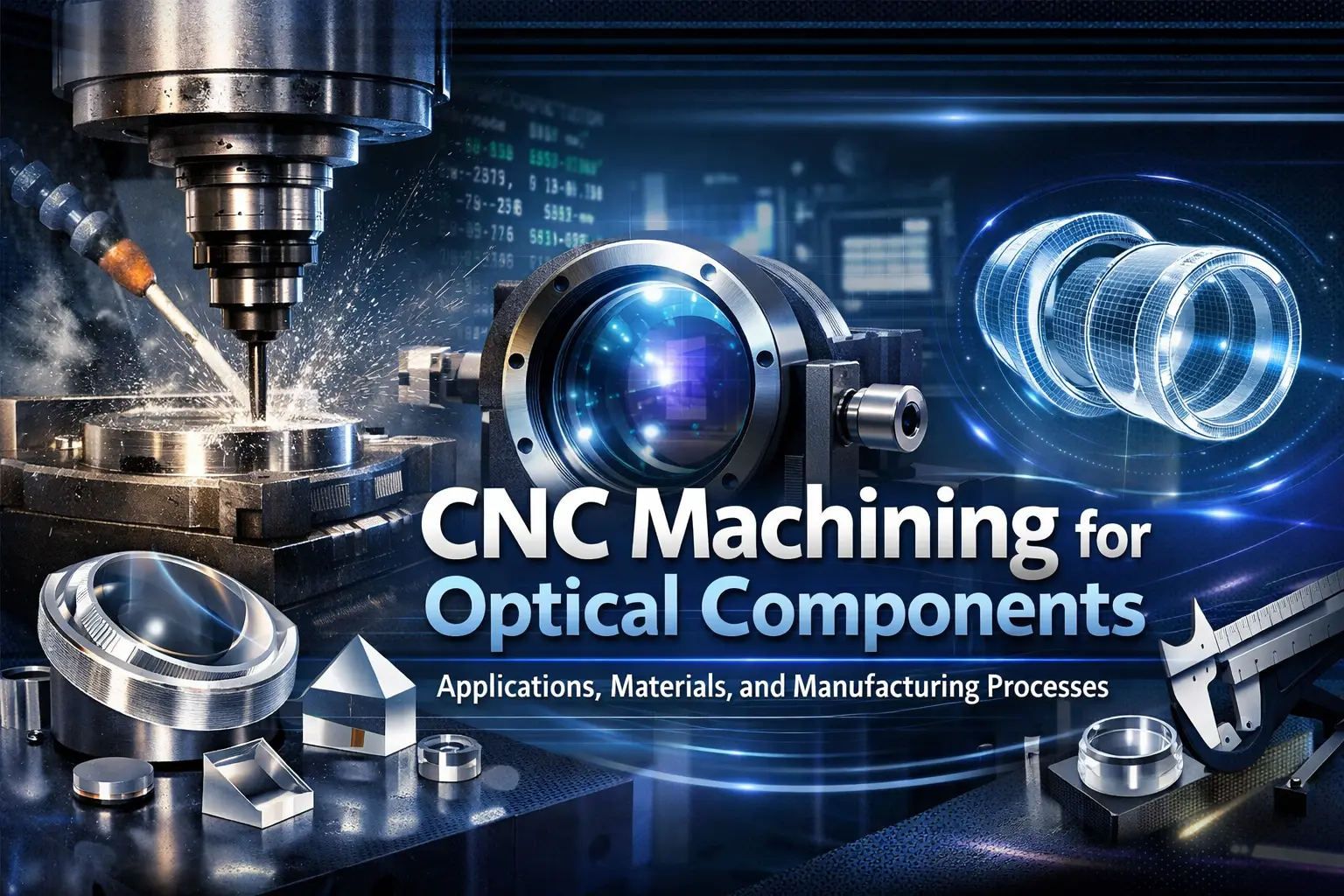
CNC machining for optical components is a high-precision manufacturing process used to produce parts that require tight tolerances, excellent surface finish, and dimensional stability. In industries such as imaging systems, medical devices, aerospace, laser technology, and photonics, optical components must maintain accurate alignment to ensure optimal performance.
Compared with traditional manufacturing methods, CNC precision machining provides superior repeatability, consistency, and flexibility. It enables the production of complex geometries such as optical housings, lens mounts, mirror brackets, sensor enclosures, and structural support components.
With advanced multi-axis CNC equipment, manufacturers can achieve high accuracy and stable quality, making CNC machining an ideal solution for optical parts production.
Key benefits include:
Material selection plays a critical role in CNC machining for optical parts. The right material ensures mechanical strength, thermal stability, corrosion resistance, and long-term reliability.
Aluminum is one of the most widely used materials for optical components. It is lightweight, easy to machine, and offers excellent dimensional stability. Common grades such as 6061 and 7075 are frequently used in optical systems due to their strength and corrosion resistance.
Aluminum is ideal for:
Stainless steel is commonly used in optical applications that require higher mechanical strength and durability. It provides excellent resistance to vibration, impact, and environmental stress.
It is suitable for:
Titanium is widely used in aerospace and defense optical systems. It offers a superior strength-to-weight ratio and outstanding corrosion resistance. Although more difficult to machine, it is ideal for high-performance optical applications.
Materials such as PMMA (acrylic), polycarbonate (PC), and PEEK are commonly used in optical components requiring lightweight design or transparency. These materials are frequently used in lighting optics, protective covers, and sensor components.
Proper material selection ensures optimal optical performance, structural integrity, and manufacturing efficiency.
Precision CNC machining processes are essential to meet the strict requirements of optical component manufacturing.
Multi-axis CNC milling is widely used for producing complex optical parts. It allows manufacturers to create detailed geometries, precise mounting surfaces, and structural features while maintaining tight tolerances.
CNC turning is ideal for round components such as lens holders, spacers, and cylindrical housings. High-precision turning ensures smooth surface finishes and accurate concentricity, which are critical in optical systems.
4-axis and 5-axis CNC machining enables the production of complex optical components in a single setup. This reduces repositioning errors and improves overall dimensional accuracy.
For high-end optical applications, ultra-precision machining technologies such as diamond turning can achieve extremely fine surface finishes and micron-level accuracy. These processes are essential for advanced optical systems.
Post-processing plays an important role in CNC machining for optical parts. Common finishing methods include:
High-quality surface finishing improves durability, corrosion resistance, and aesthetic appearance.
CNC machining is widely used in the optical industry to manufacture high-precision components that require tight tolerances and excellent dimensional stability. Because optical systems depend on accurate alignment and structural reliability, CNC technology plays a key role in both prototype development and mass production.
CNC-machined components are commonly used in cameras, imaging modules, lens assemblies, and sensor housings. These parts require precise geometry to ensure proper focus, alignment, and stability.
Medical devices such as endoscopes, diagnostic imaging systems, and laser-based instruments rely on precision-machined optical components for accuracy and safety.
In aerospace applications, optical systems must withstand extreme environments. CNC machining enables the production of lightweight yet durable housings, mounts, and structural parts for advanced optical systems.
Laser equipment requires highly accurate mounting structures to maintain beam alignment. CNC machining ensures excellent repeatability and stability for these critical components.
In lighting applications, CNC-machined optical housings and reflectors help achieve precise light control and thermal management.
CNC machining offers several important advantages for optical component production:
Optical components often require micron-level accuracy. CNC equipment ensures consistent dimensional control.
Smooth surface quality is essential for optical performance. Advanced machining processes can achieve high-quality finishes suitable for demanding applications.
Multi-axis CNC machining allows the production of intricate designs that would be difficult or impossible with traditional methods.
CNC machining supports aluminum, stainless steel, titanium, and engineering plastics, providing flexibility for different optical requirements.
CNC technology is ideal for rapid prototyping as well as low-to-medium volume production, making it suitable for customized optical projects.
At WinsunProto, we provide precision CNC machining services for optical components tailored to customer specifications. Our capabilities support both prototype development and production orders.
We use advanced measurement equipment to ensure dimensional accuracy and consistent quality for every optical component.
We support custom designs, engineering collaboration, and DFM optimization to improve manufacturability and reduce production costs.
Modern CNC machining can achieve extremely tight tolerances, depending on design complexity and material selection.
Yes. With proper tooling and finishing processes, CNC machining can produce smooth surfaces suitable for optical applications.
Aluminum is widely used for optical housings, while stainless steel and titanium are used for high-strength applications. Engineering plastics are also common in lightweight designs.
Yes. Multi-axis CNC machines can produce highly complex shapes with excellent accuracy.
CNC machining plays a vital role in the optical industry by enabling the production of high-precision, durable, and complex components. From camera systems and medical devices to aerospace and laser applications, CNC technology ensures dimensional accuracy, excellent surface quality, and consistent performance.
With advanced equipment, multiple material options, and strict quality control, CNC machining remains one of the most reliable manufacturing solutions for optical components.
