Our Location
304 North Cardinal St.
Dorchester Center, MA 02124

304 North Cardinal St.
Dorchester Center, MA 02124

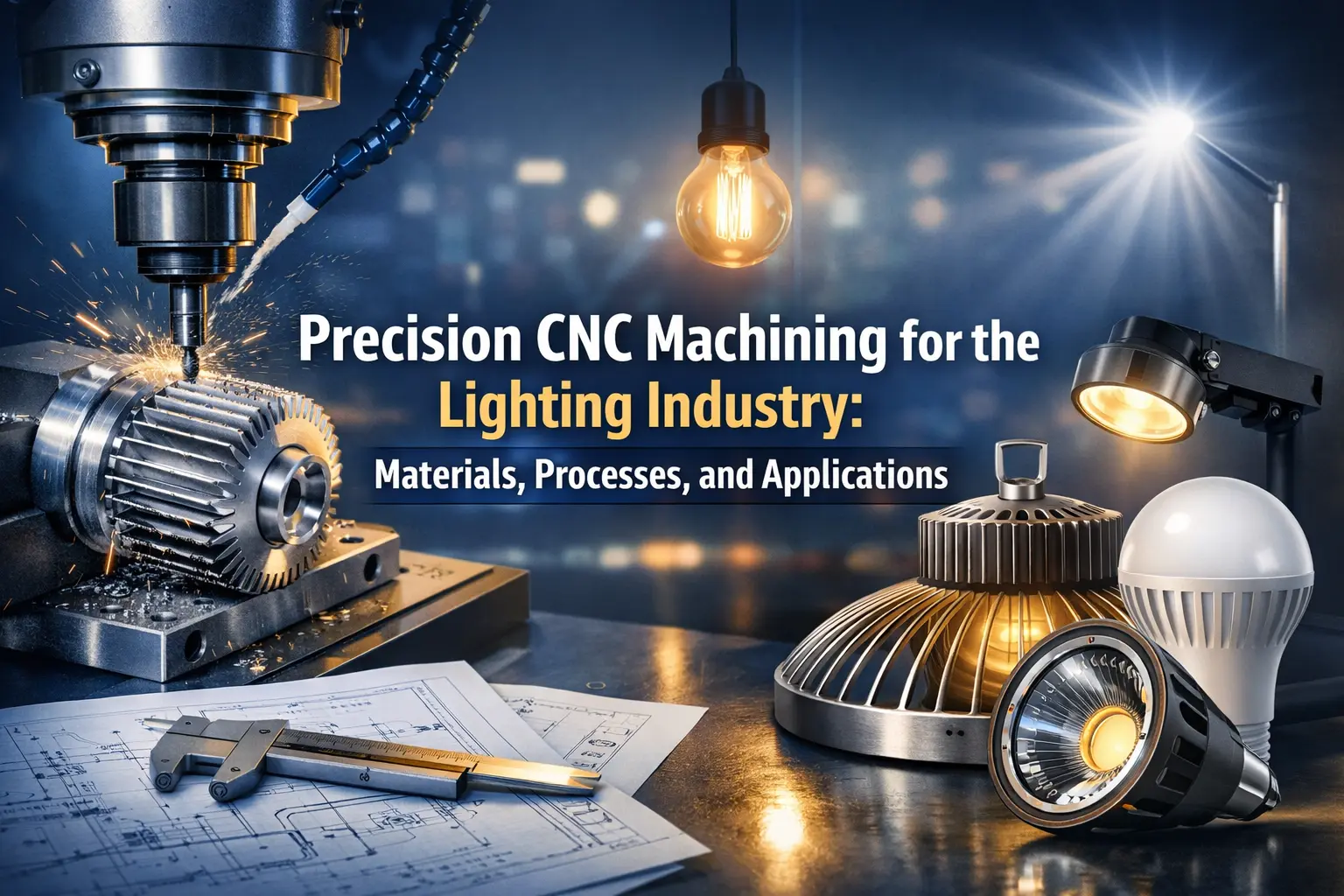
The lighting industry has undergone rapid transformation in recent years, driven by the widespread adoption of LED technology, smart lighting systems, and increasingly customized design requirements. Modern lighting products are no longer just functional devices—they combine aesthetics, thermal performance, and structural precision to meet both technical and architectural demands.
To achieve these high standards, manufacturers are turning to CNC machining as a reliable and flexible production solution. CNC (Computer Numerical Control) machining enables the precise fabrication of complex lighting components with tight tolerances and excellent surface finishes. From heat sinks and housings to decorative elements and structural parts, CNC machining plays a critical role in ensuring product quality, durability, and performance.
In this article, we will explore how CNC machining is applied in the lighting industry, including key materials, manufacturing processes, design considerations, and its advantages for modern lighting applications.
CNC machining in the lighting industry refers to the use of computer-controlled manufacturing processes to produce high-precision components used in lighting fixtures and systems. By utilizing advanced CNC equipment such as milling machines, lathes, and multi-axis machining centers, manufacturers can create complex geometries and detailed features that are difficult or impossible to achieve with traditional methods.
In lighting applications, CNC machining is widely used to produce critical components such as aluminum housings, LED heat sinks, mounting brackets, reflectors, and connectors. These parts often require not only precise dimensions but also optimized thermal management and high-quality surface finishes.
Compared to conventional manufacturing processes, CNC machining offers greater flexibility for custom designs, rapid prototyping, and small-to-medium production runs. This makes it especially suitable for the lighting industry, where product designs frequently evolve and demand both performance and visual appeal.
By integrating CNC machining into lighting production, manufacturers can achieve superior consistency, improved product functionality, and faster time-to-market.
Selecting the right material is essential for ensuring the performance, durability, and aesthetics of lighting components. Different materials offer unique advantages depending on the application requirements.
Aluminum is the most widely used material in the lighting industry due to its lightweight properties, excellent thermal conductivity, and corrosion resistance. It is especially ideal for LED housings and heat sinks where efficient heat dissipation is critical.
Stainless steel is commonly used in outdoor and industrial lighting applications. Its high strength and resistance to corrosion make it suitable for harsh environments where durability is a priority.
Brass is often chosen for decorative lighting components because of its premium appearance and good machinability. It also offers decent electrical conductivity, making it suitable for certain connectors and fittings.
Plastics such as ABS and polycarbonate (PC) are used for insulation parts, diffusers, and lightweight structural components. They provide cost advantages and design flexibility, especially for complex shapes.
By carefully selecting materials, manufacturers can balance performance, cost, and design requirements in lighting products.
A variety of CNC machining processes are used to manufacture lighting components with precision and efficiency.
CNC milling is one of the most common processes, used to create complex geometries, intricate contours, and detailed features in lighting housings and structural parts.
CNC turning is ideal for producing cylindrical components such as lamp holders, connectors, and threaded parts with high accuracy.
Drilling and tapping are essential for creating mounting holes and threaded features required for assembly and installation.
Surface finishing processes play a crucial role in both functionality and appearance. Common finishes include anodizing for corrosion resistance and enhanced aesthetics, sandblasting for a uniform matte texture, and polishing for a high-end decorative look.
These processes can be combined to produce high-quality lighting components that meet both technical and visual standards.
Designing lighting components for CNC machining requires careful attention to both performance and manufacturability.
One of the most critical factors is heat dissipation, especially for LED lighting. Proper thermal management ensures longer lifespan and stable performance of lighting systems.
Structural strength and weight optimization are also important. Components must be strong enough to ensure durability while remaining lightweight for ease of installation and energy efficiency.
Surface quality and aesthetics play a significant role, particularly in architectural and decorative lighting. CNC machining allows for high-quality finishes that enhance the visual appeal of the final product.
Tolerance and precision are essential to ensure proper assembly and compatibility with other components. Tight tolerances help maintain consistency and reliability across production batches.
Additionally, applying Design for Manufacturability (DFM) principles can reduce production costs and improve efficiency by optimizing designs for CNC processes.
CNC machining is widely used across various segments of the lighting industry, supporting both functional and decorative applications.
It is commonly used in the production of LED housings and heat sinks, where precise machining ensures effective thermal management.
In industrial lighting, CNC-machined components provide the durability and strength required for demanding environments.
For outdoor lighting, CNC machining enables the creation of weather-resistant parts with high structural integrity and corrosion resistance.
In architectural and decorative lighting, CNC machining allows for intricate designs, custom shapes, and premium surface finishes that enhance visual impact.
Additionally, CNC machining plays an important role in smart lighting systems, where precision components are required to integrate sensors, electronics, and advanced control features.
These diverse applications highlight the versatility and importance of CNC machining in modern lighting manufacturing.
CNC machining offers numerous advantages that make it an ideal solution for manufacturing lighting components.
One of the key benefits is high precision and consistency. CNC machines operate with tight tolerances, ensuring that each part meets exact specifications and maintains uniform quality across production batches.
Another advantage is excellent flexibility for custom designs. As lighting products increasingly require unique shapes and tailored solutions, CNC machining allows manufacturers to easily adapt designs without the need for expensive tooling changes.
Rapid prototyping is also a major benefit. CNC machining enables quick production of functional prototypes, helping designers validate concepts and accelerate product development cycles.
In addition, CNC machining supports low-to-medium volume production, making it cost-effective for customized or specialized lighting projects.
The process also delivers superior surface finishes, which are essential for both functional performance and aesthetic appeal in lighting products.
Overall, CNC machining helps manufacturers improve efficiency, reduce lead times, and deliver high-quality lighting components.
At WinsunProto, we provide comprehensive CNC machining services tailored to the needs of the lighting industry.
We offer advanced 3-axis, 4-axis, and 5-axis CNC machining capabilities, enabling the production of complex and high-precision lighting components. Whether it is simple structural parts or intricate housings, our team ensures excellent dimensional accuracy and surface quality.
Our services cover a wide range of materials, including aluminum, stainless steel, brass, and engineering plastics, allowing us to meet diverse application requirements.
We support customers throughout the entire process—from rapid prototyping to full-scale production—ensuring flexibility and efficiency at every stage.
With a strong focus on quality control, fast turnaround times, and reliable delivery, WinsunProto is committed to helping clients bring innovative lighting products to market quickly and successfully.
Is CNC machining suitable for LED heat sinks?
Yes, CNC machining is highly suitable for manufacturing LED heat sinks, especially when precise geometries and efficient thermal management are required.
Which material is best for lighting components?
Aluminum is the most commonly used material due to its lightweight properties and excellent heat dissipation. However, stainless steel, brass, and plastics may also be used depending on the application.
How does CNC machining compare to die casting for lighting parts?
CNC machining offers higher precision and flexibility, making it ideal for prototyping and low-volume production. Die casting is more suitable for high-volume manufacturing but requires higher upfront tooling costs.
What tolerances can CNC machining achieve?
CNC machining can typically achieve tolerances as tight as ±0.01 mm, depending on the material and part complexity.
Can CNC machining provide high-quality surface finishes?
Yes, various surface finishing options such as anodizing, polishing, and sandblasting can be applied to enhance both functionality and appearance.
CNC machining has become an essential manufacturing solution in the lighting industry, enabling the production of high-precision, durable, and visually appealing components. From heat sinks and housings to decorative elements and structural parts, CNC technology supports a wide range of applications.
As lighting products continue to evolve toward greater customization, performance, and smart integration, CNC machining offers the flexibility and reliability needed to meet these demands.
By partnering with an experienced CNC machining provider, manufacturers can accelerate product development, ensure consistent quality, and stay competitive in a rapidly changing market.
If you are looking for reliable CNC machining solutions for your lighting projects, WinsunProto is ready to support your needs from prototype to production.
Ready to Bring Your Lighting Components to Life?
Whether you need rapid prototypes or full-scale production, our CNC machining experts are here to support your lighting projects with precision, speed, and reliability.
Send us your drawings or requirements today at [email protected]
We will provide a fast and competitive quote—often within 24 hours.
Let’s turn your ideas into high-performance lighting components.

Rapid Prototyping & CNC Machining Expert
Freja specializes in CNC machining, rapid prototyping, injection molding, and metal finishing. She helps global companies transform product designs into high-precision parts and production solutions.



