Our Location
304 North Cardinal St.
Dorchester Center, MA 02124

304 North Cardinal St.
Dorchester Center, MA 02124

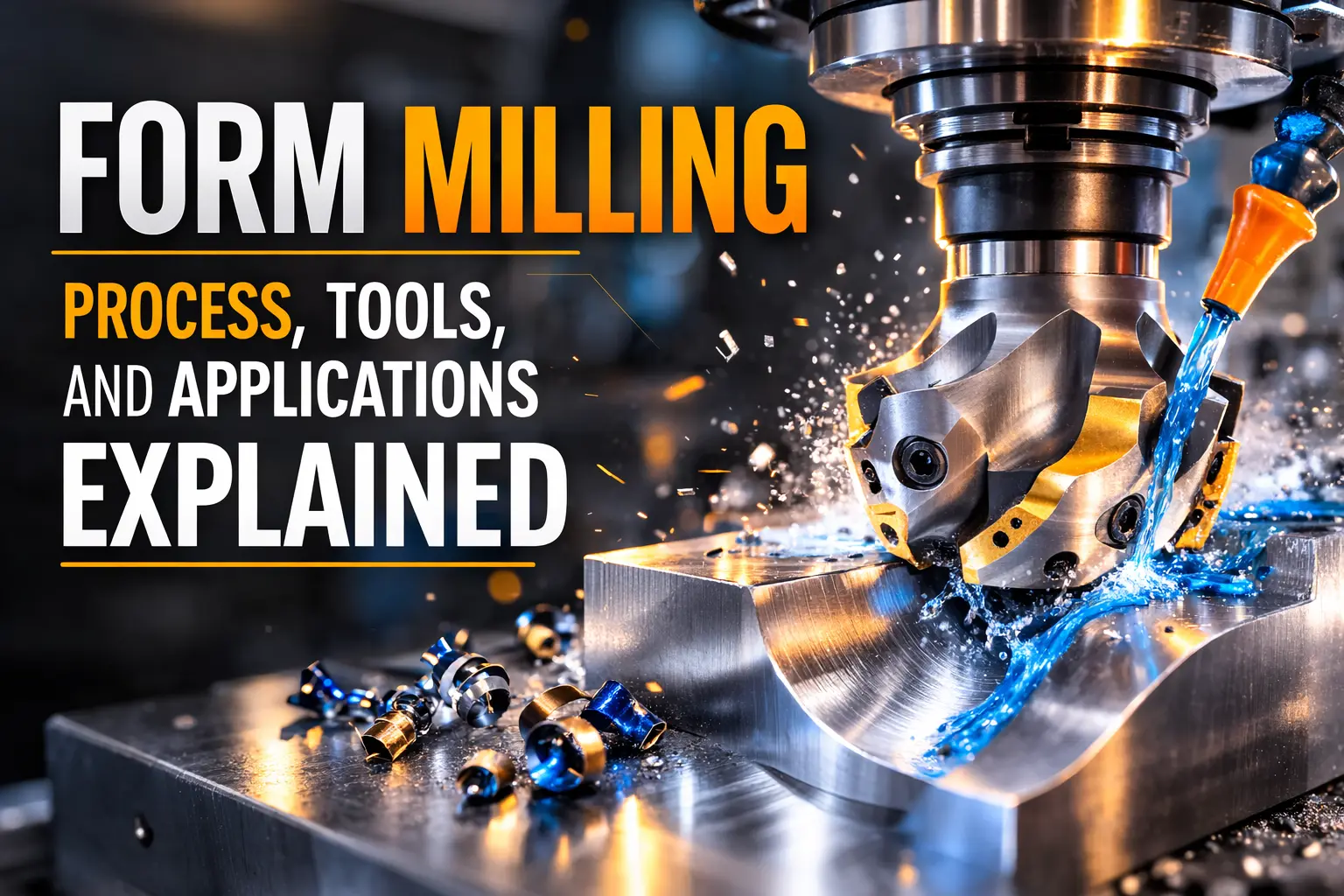
Milling is one of the most widely used machining processes in modern manufacturing. By rotating a cutting tool against a stationary or moving workpiece, milling machines can remove material with high precision and efficiency. From simple flat surfaces to complex three-dimensional geometries, milling plays a critical role in producing components for industries such as aerospace, automotive, electronics, and industrial equipment. With the development of CNC technology, milling has become even more precise, automated, and capable of handling intricate part designs.
Among the various milling techniques, form milling stands out for its ability to create specific profiles and contours in a single machining operation. Unlike standard milling operations—such as face milling or end milling—that primarily produce flat surfaces or simple features, form milling uses specially designed cutters that match the exact shape required on the workpiece. This allows manufacturers to produce complex curves, grooves, and detailed profiles with high consistency and accuracy.
Form milling is particularly important when manufacturing parts that require repeated, precise shapes. By using a cutter that already contains the desired profile, manufacturers can machine complex geometries more efficiently while maintaining excellent dimensional accuracy. As a result, form milling is commonly used in applications such as gear production, curved surfaces, and custom mechanical components where precision and repeatability are essential.
Form milling is a specialized milling process used to machine complex shapes, contours, or profiles on a workpiece using a cutting tool that has a specific, pre-designed shape. In this process, the cutting edges of the milling cutter are manufactured to match the desired profile, allowing the shape to be reproduced directly on the part during machining.
Unlike conventional milling operations that typically create flat surfaces or simple slots, form milling enables manufacturers to produce curved surfaces, irregular grooves, and intricate profiles in a single pass. The cutter’s geometry determines the final shape of the machined feature, making the process highly efficient for parts that require consistent and repeated profiles.
Form milling is widely used in CNC machining environments because it allows for precise, repeatable results while reducing the need for multiple machining operations. It is commonly applied in the production of gears, splines, rounded edges, and other complex mechanical features.
The form milling process involves several key steps to ensure accurate machining and high-quality results.
The process begins with defining the required shape or contour of the part. Engineers typically use CAD software to design the profile and determine the exact dimensions and geometry that must be reproduced during machining.
A form cutter with a profile matching the desired shape is selected or custom manufactured. The accuracy of the cutter is critical because the cutter’s geometry directly determines the final form of the machined feature.
The workpiece is securely clamped onto the milling machine table or fixture. Proper alignment of the cutter and the workpiece ensures that the profile is machined accurately and consistently.
During machining, the rotating form cutter engages the material and removes excess material while transferring its shape onto the workpiece. Cutting parameters such as spindle speed, feed rate, and depth of cut must be carefully controlled to achieve the desired surface finish and dimensional accuracy.
Different types of form milling cutters are designed to produce specific shapes and profiles. The selection of the appropriate cutter depends on the geometry of the part being machined.
Convex cutters are used to machine curved external surfaces. They are commonly applied when producing rounded contours on the outer surfaces of components.
Concave cutters are designed for machining internal curved surfaces or grooves. These cutters are frequently used when producing parts that require internal radii or curved channels.
Corner rounding cutters are used to create smooth, rounded edges on a workpiece. They are widely used in applications where sharp edges must be removed to improve safety, aesthetics, or structural performance.
Gear cutters are specialized form milling tools designed for producing gear teeth profiles. They are essential in gear manufacturing and are available in various sizes and profiles depending on the gear specifications.
For complex or unique component designs, custom form cutters can be manufactured to match the exact shape required. These cutters allow manufacturers to efficiently produce specialized parts with intricate geometries.
Form milling can be applied to a wide range of materials commonly used in manufacturing. However, the material properties influence tool selection, cutting parameters, and overall machining efficiency.
Aluminum is one of the most commonly machined materials due to its good machinability, lightweight properties, and ability to achieve excellent surface finishes.
Stainless steel offers high strength and corrosion resistance but requires careful control of cutting speeds and tool materials due to its toughness and tendency to generate heat during machining.
Carbon steel is widely used in industrial applications and can be efficiently machined using form milling tools with appropriate coatings and cutting conditions.
These materials are relatively easy to machine and are often used in applications requiring good electrical conductivity or corrosion resistance.
Certain plastics and polymers can also be machined using form milling, especially when producing lightweight components or prototypes with complex shapes.
Selecting the right cutting tools, speeds, and feeds is essential when machining different materials to ensure tool longevity, dimensional accuracy, and high-quality surface finishes.
Form milling offers several advantages that make it a valuable machining method for producing complex profiles and repeated shapes.
Because the cutter is designed with the exact shape required, form milling can produce intricate contours and profiles with high dimensional accuracy.
Form milling allows complex shapes to be machined in a single operation. This reduces machining time and minimizes the need for multiple cutting passes or secondary processes.
Once the correct cutter and machining parameters are set, form milling can produce identical features repeatedly. This makes it particularly suitable for batch and mass production.
By using a cutter that already contains the required profile, manufacturers can eliminate additional machining operations, improving overall production efficiency.
Proper design planning is essential to ensure that form milling operations are efficient, accurate, and cost-effective.
The geometry of the form cutter must precisely match the required profile. Even small deviations in cutter design can affect the final shape of the machined part.
Different materials respond differently to machining. Factors such as hardness, toughness, and thermal properties must be considered when selecting cutting tools and parameters.
Form cutters can experience wear over time, especially when machining harder materials. Regular inspection and maintenance help maintain consistent part quality.
Appropriate spindle speeds, feed rates, and depth of cut must be carefully selected to achieve the desired surface finish while avoiding excessive tool wear.
Custom form cutters can involve higher upfront costs, so they are often more economical when used for medium- to high-volume production runs.
Form milling is widely used in industries where parts require complex profiles or consistent contour shapes.
Form milling cutters are commonly used to produce gear teeth profiles, ensuring precise geometry and smooth operation.
In aerospace manufacturing, form milling is used to machine curved surfaces, slots, and complex profiles in structural components.
Automotive components often require grooves, splines, and contoured features that can be efficiently produced using form milling.
Form milling is frequently used in mold and die production to create detailed shapes and contours needed for plastic injection molding or metal forming.
Many specialized mechanical parts require unique profiles that can be efficiently machined using custom form cutters.
Understanding how form milling differs from other milling methods helps manufacturers select the most suitable machining process.
End milling typically uses a cylindrical tool to create flat surfaces, slots, and pockets. In contrast, form milling uses a cutter with a specific profile to generate complex shapes directly on the workpiece.
Profile milling usually involves CNC-controlled tool paths that gradually shape the workpiece. Form milling, however, transfers the cutter’s shape directly to the material in a single pass.
Form milling is ideal when a part requires a consistent, repeated profile that can be produced efficiently with a dedicated cutter.
At WinsunProto, we provide precision CNC milling services capable of producing complex geometries and high-quality machined components. Our advanced CNC equipment and experienced engineering team enable us to handle both standard and custom milling requirements.
We support a wide range of materials, including aluminum alloys, stainless steel, carbon steel, brass, copper, and engineering plastics. With strict quality control processes and modern machining technologies, we ensure excellent dimensional accuracy and surface finish for every project.
Whether you need prototypes, small batches, or large production runs, our team can provide reliable machining solutions tailored to your design and manufacturing requirements.
What is the main purpose of form milling?
Form milling is used to produce specific shapes or profiles on a workpiece using a cutter designed with the same geometry as the desired feature.
What types of parts commonly use form milling?
Parts that require grooves, curved surfaces, gear teeth, splines, or other complex contours are often produced using form milling.
Is form milling suitable for high-volume production?
Yes. Because the cutter already contains the required profile, form milling is highly efficient for producing repeated shapes in medium- to large-scale production.
What materials can be machined using form milling?
Form milling can be used on a variety of materials, including aluminum, steel, stainless steel, brass, copper, and many engineering plastics.
How accurate is form milling?
When properly set up with high-quality cutters and correct machining parameters, form milling can achieve excellent dimensional accuracy and consistent results.
Form milling is an effective machining method for producing complex profiles, contours, and detailed shapes with high precision and efficiency. By using specially designed cutters that match the desired geometry, manufacturers can achieve consistent results while reducing machining time and the number of required operations.
This process is widely used in industries such as aerospace, automotive, and mold manufacturing, where precision and repeatability are essential. With proper tool selection, optimized machining parameters, and careful design considerations, form milling can significantly improve manufacturing efficiency and product quality.
For companies seeking reliable machining solutions, professional CNC milling services ensure that complex components are produced accurately and efficiently, meeting the demanding requirements of modern manufacturing.

Rapid Prototyping & CNC Machining Expert
Freja specializes in CNC machining, rapid prototyping, injection molding, and metal finishing. She helps global companies transform product designs into high-precision parts and production solutions.



